
Tire pressure sensors on every wheel send live readings to a screen in front of the driver and warn about a low tire before it becomes a blowout or a bus stranded with students on board.
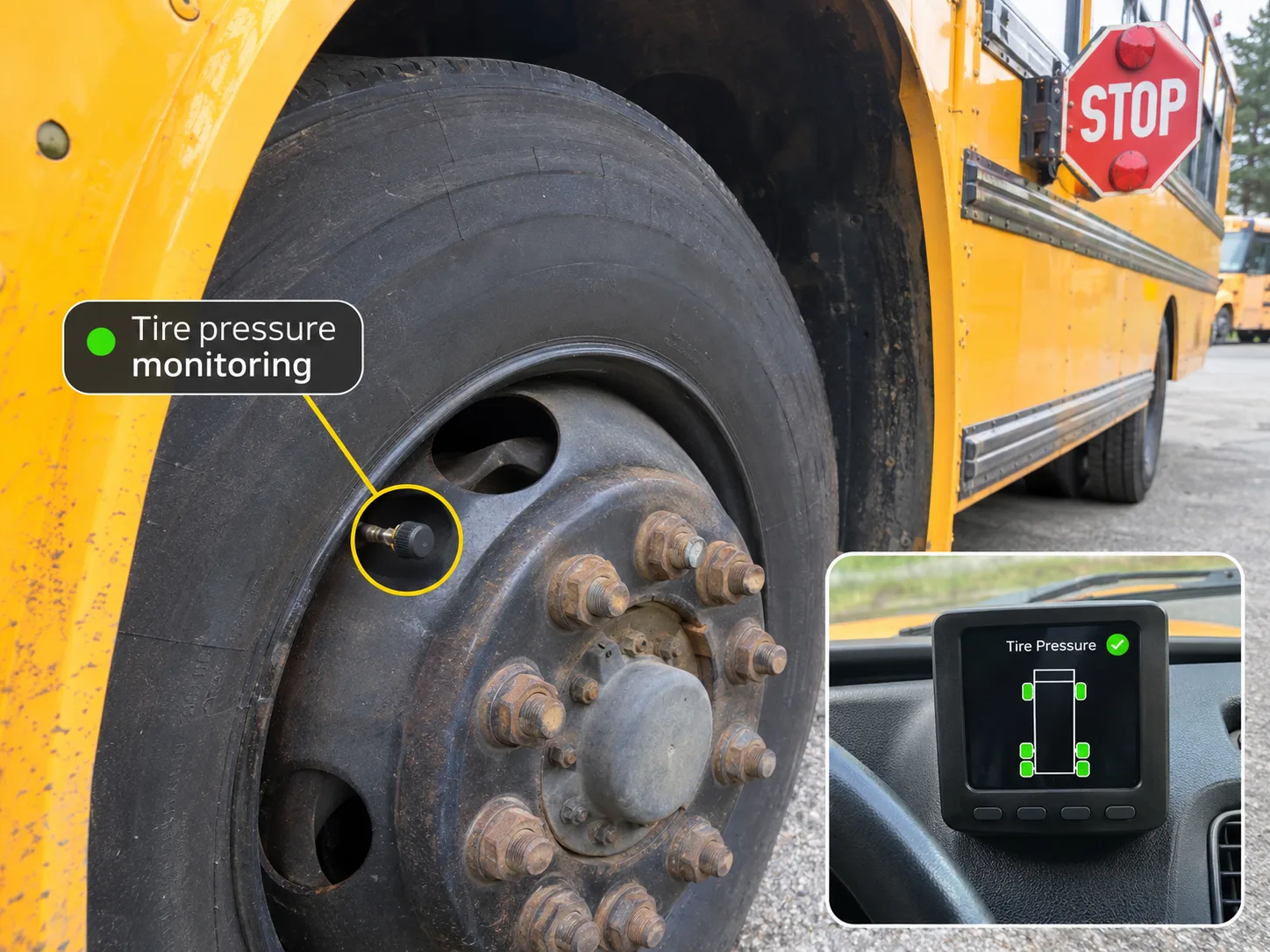
A small sensor fits on the valve stem of every tire, including the inner duals at the back. Each sensor reports pressure, and on many systems temperature, to a receiver that shows the driver a picture of the bus with every tire and flags any that are low or hot.
Inner dual tires are hard to check by eye, and a low dual can run for days until it fails. A tire failure with students on board means a stranded bus, a replacement bus and late students. Catching low pressure in the lot costs far less than a road call.
Yes. Many systems pass tire alerts to the GPS tracker, so the shop sees low tires across the whole fleet without waiting for a driver to report them.
We fit a sensor to each wheel, pair each one to its position, and mount the display where the driver can see it without blocking the view. On systems that report to the tracker, we wire the receiver in and confirm every wheel shows up on the office side before we leave.
Most systems work the same way: a sensor on each wheel, a receiver, and a display or a connection to the tracker. Some report only to the driver's screen; others also send alerts to the shop through the GPS tracker. Fleets that already run a telematics platform usually get the most from a system that feeds alerts into it, so tire problems show up in the same place as everything else.
School districts, contractors running district routes and activity bus fleets, especially those with long rural routes far from a shop. See everything else we install on our school bus tracking page.
We wire PTO monitoring into trackers from all of these brands. Need heavy duty trackers for trucks or heavy equipment? Every brand below makes them, so pick yours and we install it.
Common questions
Most sensors have sealed batteries that last years. When one runs low, the sensor is replaced.
No. It adds a constant check between inspections.
Yes. Valve stem sensors fit almost any bus wheel.
Yes. Inner dual valve stems often need an extension so the sensor can be reached, and we add those where needed.
The display shows the bus outline with the problem tire highlighted and a warning, so the driver knows exactly which wheel to check.
We install across Georgia, South Carolina, North Carolina, Tennessee, Virginia, Alabama, Florida and Mississippi, at your yard, on your schedule. Call or text 803-513-1009.
Constant. Ignition. Ground.
API Signal