
A rugged router in the overhead cabinet keeps the school bus online, giving students Wi-Fi for homework on long rides and giving the onboard equipment a connection to report back.
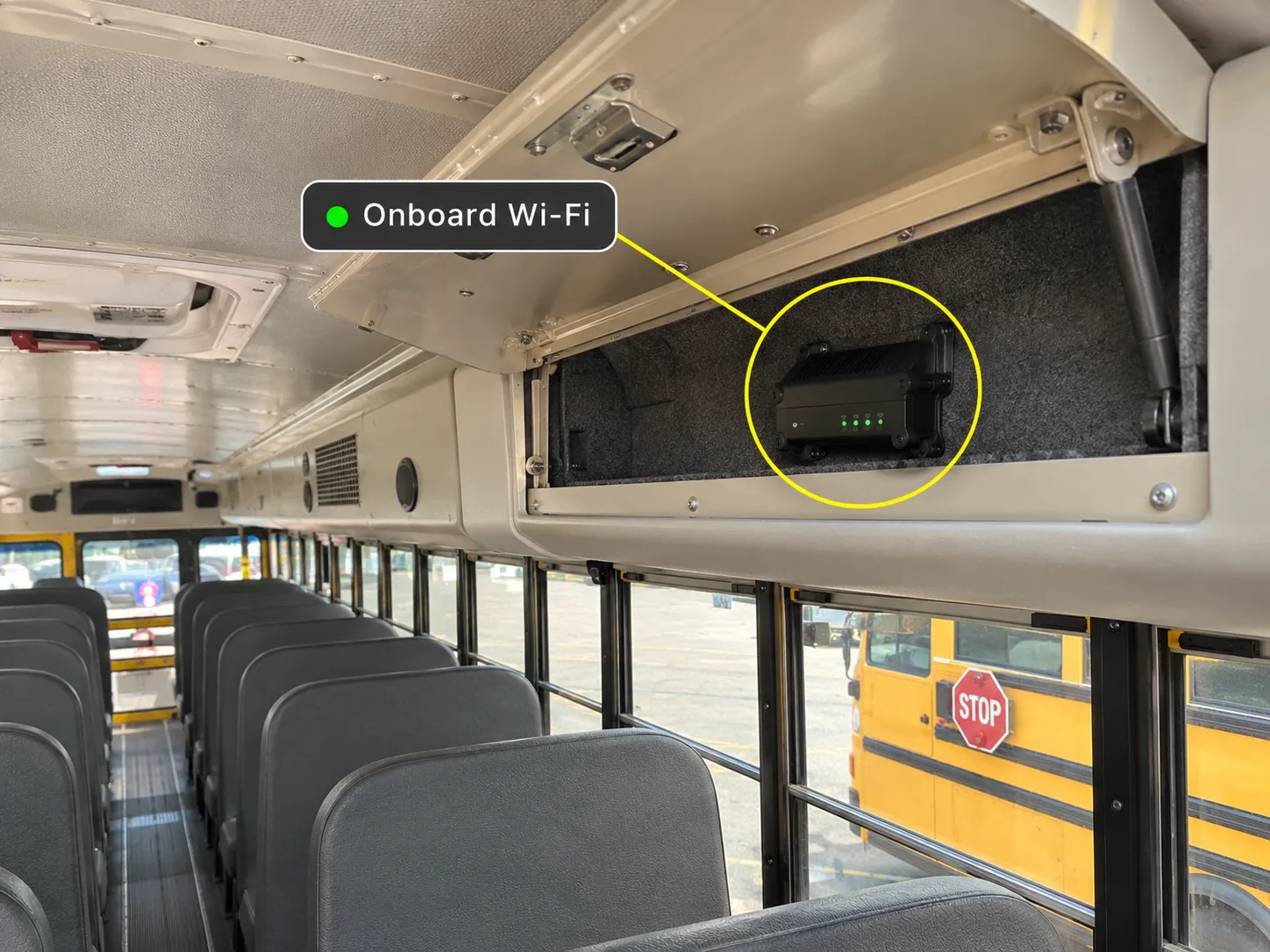
In a lockable overhead cabinet, usually near the front, out of reach of students. The antennas mount where they get the best signal, and the router takes power from a fused circuit that switches with the bus, so it is on when the bus is running and off when it is parked.
Phone hotspots overheat, get lost and struggle with a full bus of devices. A vehicle router is built for vibration and heat, uses external antennas for better signal on rural roads, and can be managed and filtered centrally by the district's IT team.
We mount the router to the cabinet's back panel, route the power and antenna cables behind the panels, and fuse the power feed. Before we leave, we confirm the router powers up with the bus, connects to the cellular network and puts out a usable signal down the full length of the bus.
Yes. The router uses a cellular data plan, usually set up through the district or its carrier. We install and connect the hardware; the plan and filtering rules are set by the district.
Only as well as the cellular coverage along the route. A vehicle router with external antennas holds a signal far better than a phone, and some routers can switch between carriers, but remote areas will still have dead spots. Before a district commits a whole fleet, it is worth putting one router on its longest rural route to see where the signal drops.
If the bus already has a tracker or cameras with their own cellular connection, those keep working on their own unless the district wants them moved onto the router.
Districts with long rural routes, athletic and activity trips, and districts using the bus connection for cameras and ridership systems. See everything else we install on our school bus tracking page.
We wire PTO monitoring into trackers from all of these brands. Need heavy duty trackers for trucks or heavy equipment? Every brand below makes them, so pick yours and we install it.
Common questions
It is wired to switch off with the bus, so it does not run the battery down while parked.
No. Filtering is set by the district, usually through the router's management software or the district's own filter.
Many can, on separate networks so student traffic and equipment traffic stay apart.
Usually not. Most trackers have their own built-in cellular connection used only for tracking.
We install across Georgia, South Carolina, North Carolina, Tennessee, Virginia, Alabama, Florida and Mississippi, at your yard, on your schedule. Call or text 803-513-1009.
Constant. Ignition. Ground.
API Signal