
Tire pressure sensors on every wheel of a transit bus report pressure to the driver and the shop, catching low tires before they fail on a route full of riders. We install them at your depot across Georgia, South Carolina, North Carolina, Tennessee, Virginia, Alabama, Florida and Mississippi.
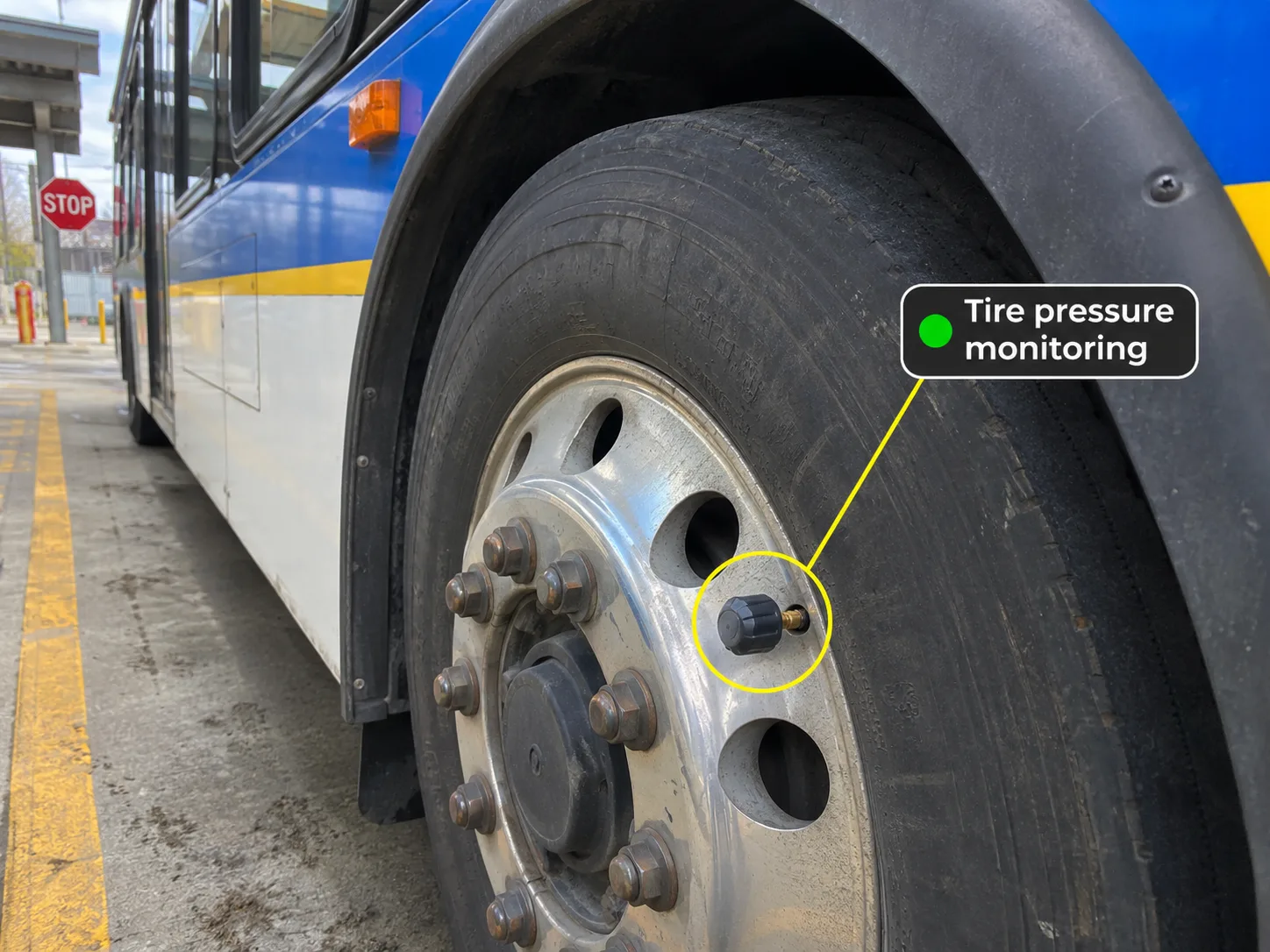
A sensor fits on the valve stem of each tire, including the rear duals. Each one reports pressure, and on many systems temperature, to a receiver that alerts the driver and can pass the alert to the shop.
A tire failure in service means a road call, a replacement bus and riders left waiting at stops. Transit buses run long hours under heavy loads, and low pressure wears tires faster and costs fuel. A morning check cannot catch a leak that starts at noon.
Correct pressure also matters for cost. Underinflated tires wear faster on the shoulders and make the engine work harder, so keeping every tire at the right pressure saves money on both tires and fuel across a fleet.
Yes. Many systems pass tire alerts to the GPS tracker, so maintenance sees low tires across the fleet and can swap a bus out before it fails.
We fit and pair a sensor to each wheel position, add valve extensions on the inner duals where needed, and mount the display or connect the receiver to the tracker. Before we leave, we confirm every wheel reports in the right position.
Most systems work the same way: a sensor on each wheel, a receiver, and a display or a connection to the tracker. Agencies that already run a telematics platform usually get the most from a system that feeds alerts into it, so tire problems show up in the same place as everything else.
City and county transit agencies, paratransit operators, university, hospital and airport shuttles, and private contractors running fixed routes. See everything we install on a transit bus on our transit bus tracking page.
We wire PTO monitoring into trackers from all of these brands. Need heavy duty trackers for trucks or heavy equipment? Every brand below makes them, so pick yours and we install it.
Common questions
Most have sealed batteries that last years. When one runs low, the sensor is replaced.
No. It adds a constant check between inspections.
Yes. Valve stem sensors fit almost any bus wheel.
Yes. Inner dual valve stems often need an extension so the sensor can be reached, and we add those where needed.
A warning on the display showing which wheel is low or hot, so the driver can report it right away.
We install across Georgia, South Carolina, North Carolina, Tennessee, Virginia, Alabama, Florida and Mississippi, at your yard, on your schedule. Call or text 803-513-1009.
Constant. Ignition. Ground.
API Signal