
A plow log shows where the truck drove. A spreader record shows where the salt actually went down. We wire salt and sand spreaders into the GPS tracker so every pass is recorded with a time and a place, for public works departments and private snow contractors across Georgia, South Carolina, North Carolina, Tennessee, Virginia, Alabama, Florida and Mississippi.
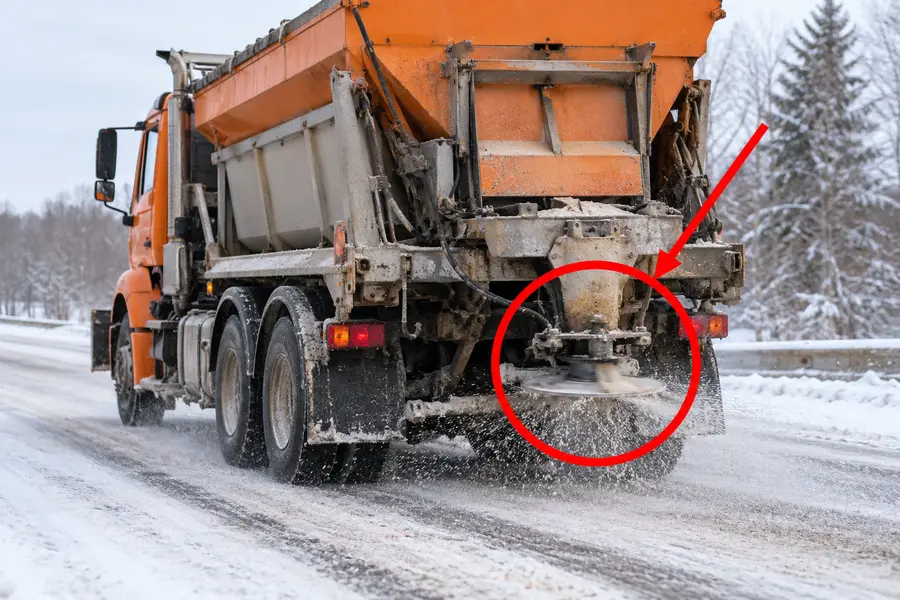
During a storm, the questions that come in afterward are about treatment, not driving. A resident says their hill was never salted. A property manager disputes a bill for three applications. An insurance claim asks whether a lot was treated before a fall. A GPS trail alone cannot answer any of those, because a truck can drive a route with the spreader off.
Spreader monitoring adds the missing fact. The platform records when the spreader was turning and where the truck was at that moment, so a route map becomes a treatment map. Supervisors can see which roads were treated during the storm without calling drivers on the radio.
Most truck mounted spreaders have two moving parts: a conveyor or auger that feeds material out of the body or hopper, and a spinner that throws it across the road. On larger trucks both are hydraulic, powered by the same central hydraulic system that lifts the dump body and raises the plow. That system is usually driven by a PTO on the transmission or by an engine mounted pump. Smaller tailgate and pickup spreaders are often electric, running straight from the truck battery through a cab switch or controller.
Many municipal trucks also carry a spreader controller in the cab. The controller sets the application rate, often adjusting it to ground speed so the same amount goes down per lane mile whether the truck is moving fast or slow. Many controllers also handle blast, a short burst for intersections and hills, and pre-wet, which sprays liquid onto the salt as it leaves the spinner.
Wire colors for the truck side are in our Vehicle Wiring Database.
City and county public works departments use it to show residents and council members which roads were treated and when. State and county road crews use it to plan routes and track material against budgets. Private contractors who salt parking lots use it to back up per-application invoices and to answer slip and fall claims with a dated, located record.
This is one of the work truck and equipment applications we wire into GPS trackers. See all of them on our PTO and equipment monitoring page, and find wire colors for your truck in our Vehicle Wiring Database.
We wire PTO monitoring into trackers from all of these brands. Need heavy duty trackers for trucks or heavy equipment? Every brand below makes them, so pick yours and we install it.
Common questions
Yes. Once the spreader circuit or a hydraulic pressure switch is wired into an input on the tracker, the platform shows spreading as its own event with a time and location.
On some spreader controllers it can, when the controller and tracking platform support sharing that data. Spreader on and off works on almost any truck.
Yes. Electric spreaders are monitored from their power or switch circuit.
We install across Georgia, South Carolina, North Carolina, Tennessee, Virginia, Alabama, Florida and Mississippi.
We install across Georgia, South Carolina, North Carolina, Tennessee, Virginia, Alabama, Florida and Mississippi, at your yard, on your schedule. Call or text 803-513-1009.
Constant. Ignition. Ground.
API Signal