
A resistor limits the flow of current in a circuit. That's all it does, but it does it everywhere in a modern vehicle, and understanding it makes a lot of installs easier. Resistors show up in vehicle data lines, in device inputs, in bypass modules, and in our own test procedures.
A resistor is a small, non-polarized part. Non-polarized means it doesn't matter which way you put it in the circuit. The type we use is the fixed-value carbon film resistor: a small tan or blue cylinder with colored bands.
Resistors are rated three ways:
Ohms. How much resistance. Higher number, more resistance, less current flows. The symbol is the Greek letter omega, Ω. Values are often abbreviated: 2,700 ohms is written 2.7k or 2.7kΩ.
Tolerance. How close the real value is to the stated value, as a percentage. A gold band means plus or minus 5 percent. A 2,700 ohm resistor with 5 percent tolerance will actually measure between 2,565 and 2,835 ohms.
Watts. How much power the resistor can dissipate before it overheats and burns open. Most of what we do uses quarter-watt or half-watt resistors. If a resistor gets hot, it's too small for the job.
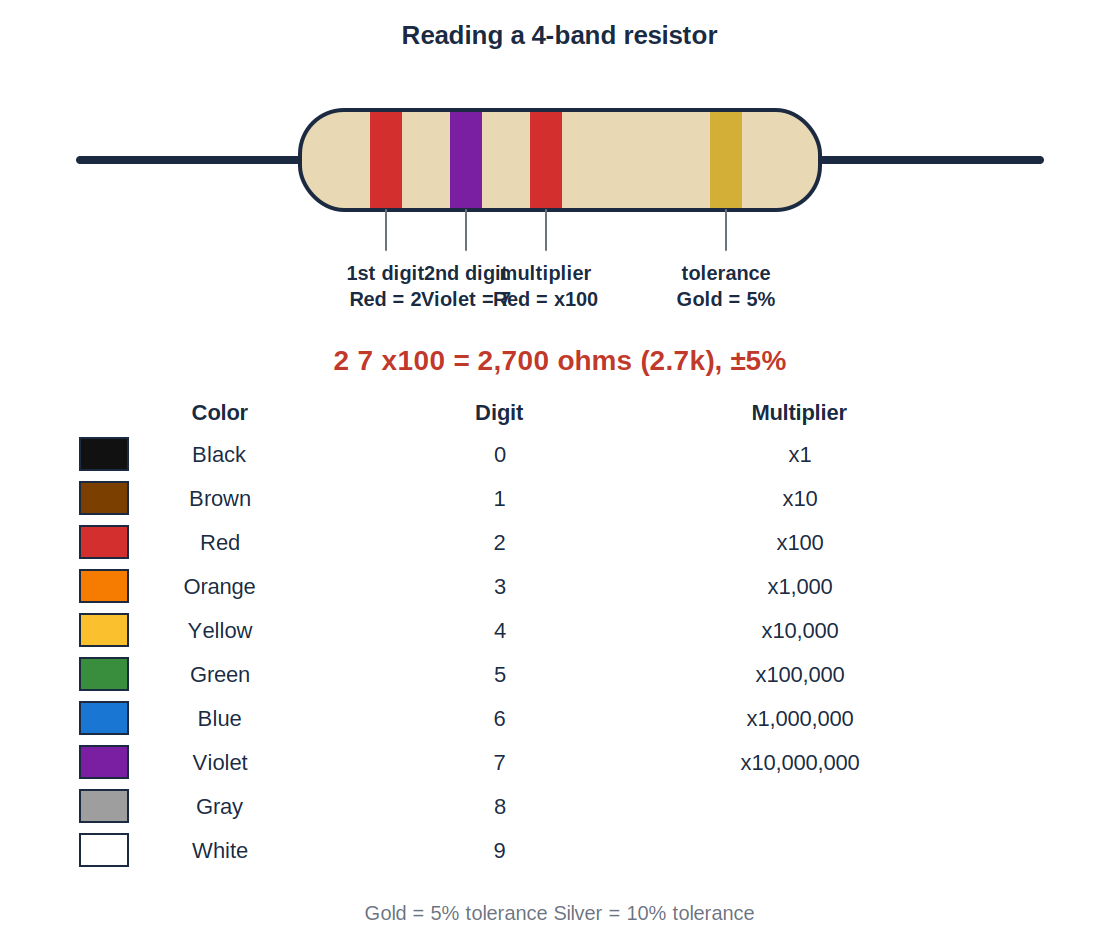
A four-band resistor reads like this:
Five-band resistors add a third digit before the multiplier.
| Color | Digit | Multiplier |
|---|---|---|
| Black | 0 | x1 |
| Brown | 1 | x10 |
| Red | 2 | x100 |
| Orange | 3 | x1,000 |
| Yellow | 4 | x10,000 |
| Green | 5 | x100,000 |
| Blue | 6 | x1,000,000 |
| Violet | 7 | x10,000,000 |
| Gray | 8 | |
| White | 9 |
Example: red, violet, red, gold = 2, 7, x100 = 2,700 ohms, 5 percent.
When in doubt, put the meter on it. Ohms setting, one lead on each end. Faster and more reliable than reading tiny bands in a dark cab.
Volts = Amps x Ohms. If you know two, you can find the third. At 12 volts, a 1,000 ohm resistor passes 12 milliamps. A 100 ohm resistor passes 120 milliamps. That's the whole reason resistors matter: they set how much current flows.
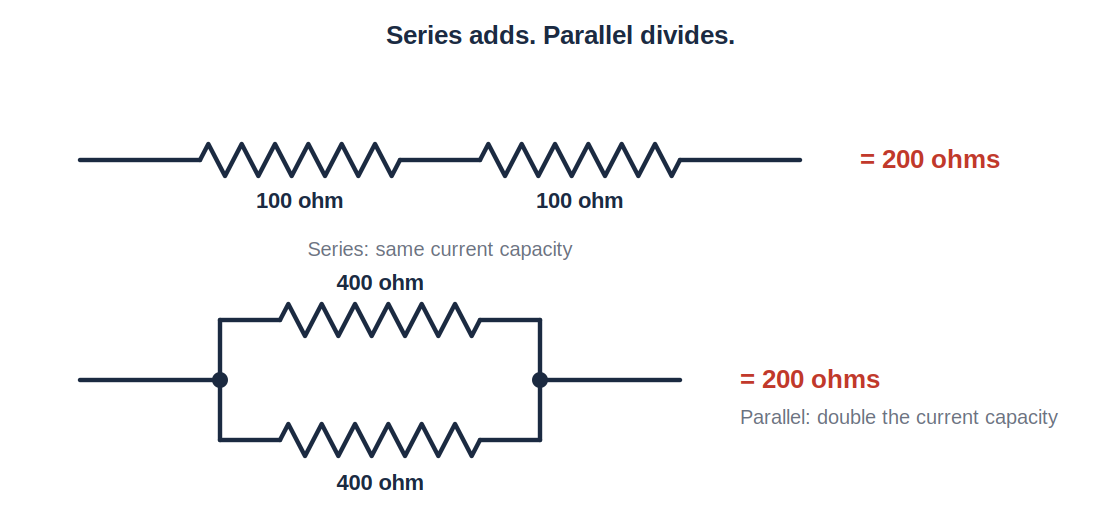
Series (end to end). Values add. Two 100 ohm resistors in series make 200 ohms. Current capacity stays the same.
Parallel (side by side). Values divide. Two 400 ohm resistors in parallel make 200 ohms. Current capacity doubles.
For two different values in parallel: total = (R1 x R2) / (R1 + R2).
For data line and trigger work, the current is so small that capacity rarely matters. Series is usually the quick fix.
Many vehicles, especially late 1990s through 2000s Chrysler, GM, and Ford products, control several body functions over one wire by sending different resistance values to the body control module. Lock might be 1,500 ohms, unlock 250 ohms, and so on. A device that needs to trigger one of those functions puts the correct resistor in line on that wire. See the Data Bus chapter for how this works.
Here are the values from the original guide. They are vehicle and year specific and were compiled in the mid 2000s. Confirm with a current wiring source before using any of them.
| Vehicle | Polarity | Lock | Unlock | Factory arm |
|---|---|---|---|---|
| 1996 Dodge Caravan, Plymouth Voyager, Chrysler Town and Country | Negative | 1,500 ohms | 250 ohms | 4,020 / 665 ohms |
| 1995 and up Dodge Stratus, Chrysler Cirrus, Plymouth Breeze | Positive | 12 volts | n/a | |
| 1989 and up Ford Probe, Mazda Millennia | Ground | 4,700 ohms | 1,000 ohms | |
| 1999 Chevrolet Alero, 1999 Pontiac Grand Am | ||||
| 1998 and up Chrysler LHS, 300, Concorde, Dodge Intrepid | 2,700 ohms | 620 ohms |
Some tracker and dash cam auxiliary inputs need a pull-up or pull-down resistor so the input reads a clean high or low instead of floating. The device manual will say so and give the value. Usually 1k to 10k.
Some vehicles use a single wire for both lock and unlock, with the direction set by resistance. To find the value the vehicle expects, measure resistance across the switch in each position with the meter, or step through values with a resistor assortment until the lock responds. Always start with a high value and work down.
Older GM VATS and Passkey systems use a resistor pellet in the key. The resistance must match one of 15 values or the vehicle won't start. Any starter interrupt or remote start work on those vehicles has to account for it. The value is measured across the key pellet with the meter.
The values below come up most in data line and trigger work. Carry an assortment.
| Ohms | Bands |
|---|---|
| 249 | red, yellow, white, black, brown |
| 330 | orange, orange, brown, gold |
| 390 | orange, white, brown, gold |
| 470 | yellow, violet, brown, gold |
| 560 | green, blue, brown, gold |
| 620 | blue, red, brown, gold |
| 750 | violet, green, brown, gold |
| 820 | gray, red, brown, gold |
| 1,000 | brown, black, red, gold |
| 1,200 | brown, red, red, gold |
| 1,500 | brown, green, red, gold |
| 2,000 | red, black, red, gold |
| 2,700 | red, violet, red, gold |
| 3,000 | orange, black, red, gold |
| 4,700 | yellow, violet, red, gold |
| 7,500 | violet, green, red, gold |
| 9,100 | white, brown, red, gold |
Rather have us do it? We install GPS, dash cams and telematics across Georgia, South Carolina, North Carolina, Tennessee, Virginia, Alabama, Florida and Mississippi, at your yard. Get a free quote or call/text 803-513-1009.
This information is provided as a guide. Verify every circuit with a digital multimeter before connecting to it. Proper installation is the responsibility of the installer.
We install GPS, dash cams and telematics across GA, SC, NC, TN, VA, AL, FL & MS — at your yard, on your schedule.