
A diode is a one-way valve for electricity. That one small part gets us out of a lot of trouble: it isolates circuits so they don't back-feed each other, it protects device outputs from voltage spikes, and it lets one input listen to several triggers at once. Every installer should carry a handful.
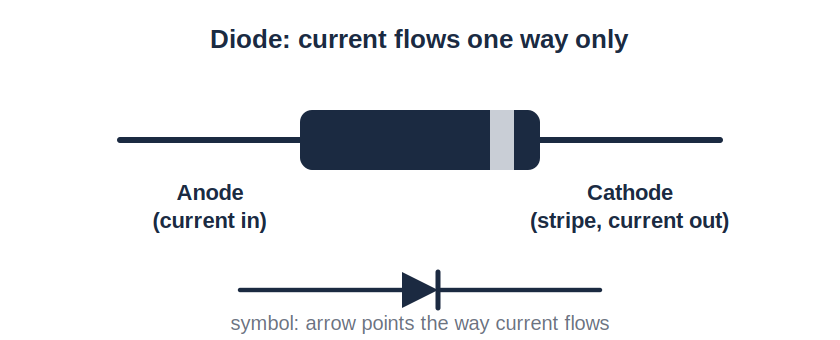
A diode lets current flow in one direction only. It has two leads:
Most diodes are a small black cylinder with a gray or silver stripe. The stripe always marks the cathode.
When the anode faces the positive side of a circuit, current flows and the diode is forward biased. Flip it around so the cathode faces positive, and current is blocked. That's reverse biased.
An easy way to remember it: the stripe is the "gate." Current can go toward the stripe, but not through it from the striped end.
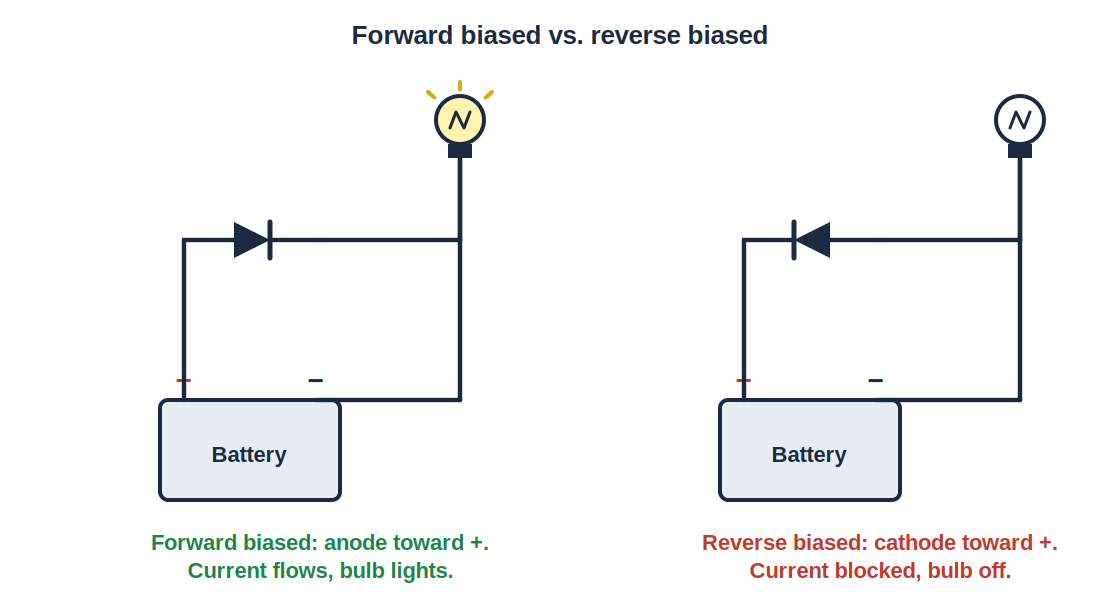
There are two ways to describe current. Conventional current flow says current goes from positive to negative. Electron flow says electrons move from negative to positive. Both describe the same thing. Wiring diagrams, including ours, use conventional flow: positive to negative, in the direction of the arrow printed on the diode symbol.
Diodes are rated by current. For most trigger and isolation work in a vehicle, a 1 amp diode (the common 1N4001 through 1N4007 family) is plenty. For anything carrying real current, like a lighting circuit, use a 6 to 10 amp diode.
Always check what the circuit actually carries with a meter before you pick the diode. A diode that's too small burns open and the circuit stops working.
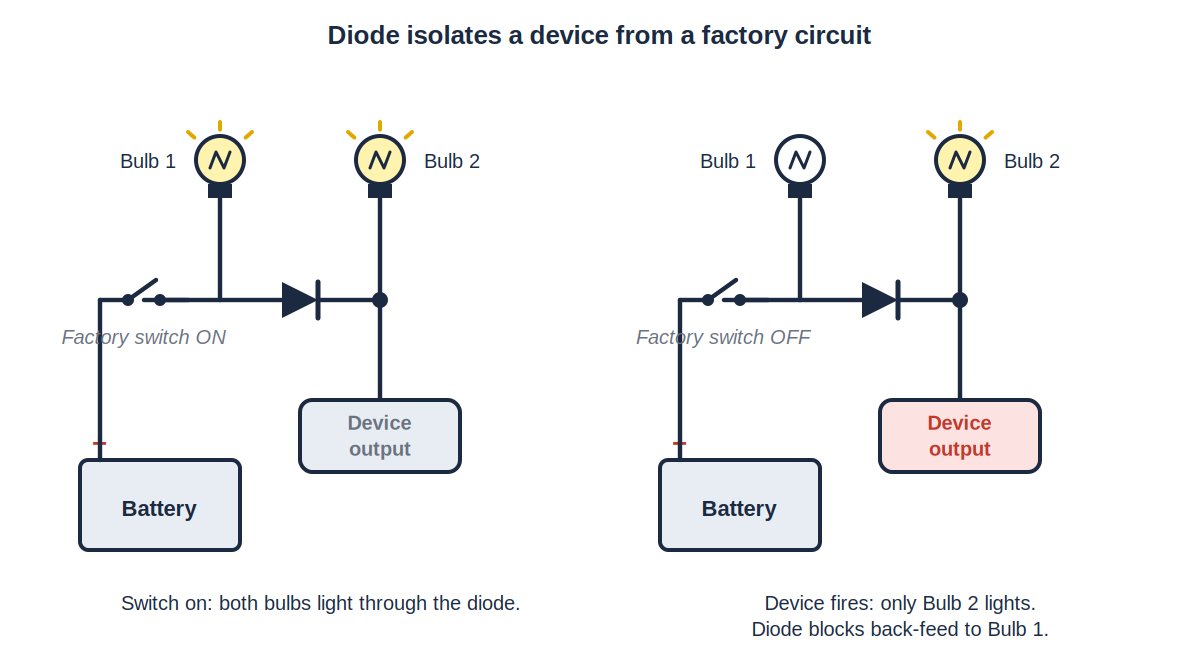
The classic example: a factory switch powers two bulbs. You want your device to turn on one bulb without lighting the other. Put a diode between your device output and the one bulb. When the factory switch is on, both bulbs light as normal. When your device fires, current goes through the diode to the one bulb and is blocked from back-feeding to the second bulb and the rest of the factory circuit.
Same principle applies to any time a device output connects to a factory circuit. The diode makes sure current goes where you want and nowhere else.
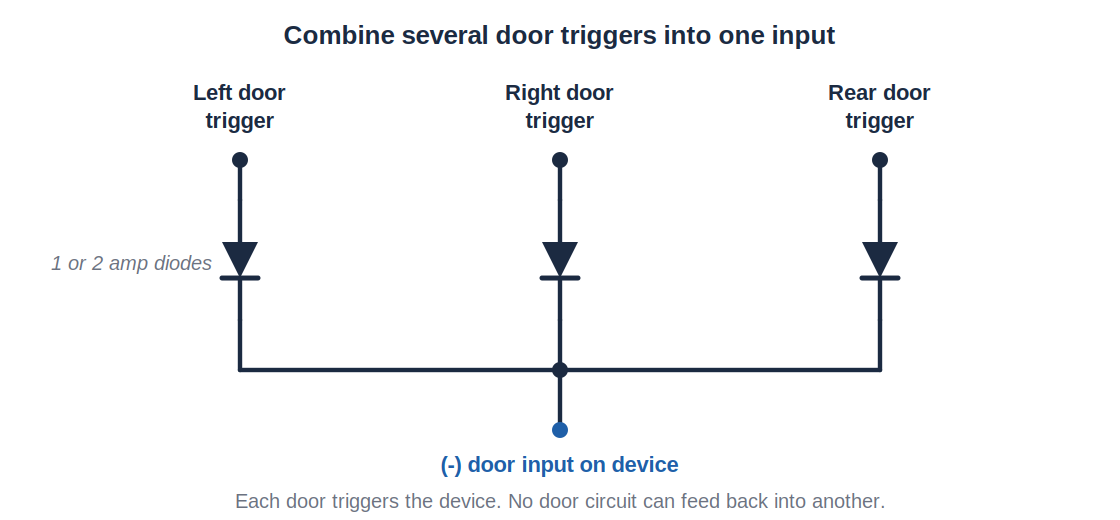
Trackers and dash cams usually have one or two auxiliary inputs. Vehicles often have separate triggers: left door and right door on many GM vehicles, front doors and rear doors on others. To feed all of them into one input, run each trigger through its own diode (stripe toward the device input) and join them at the input.
Each door still triggers the input. But no door circuit can feed back into another door circuit, so the dome light and the factory chime behave normally.
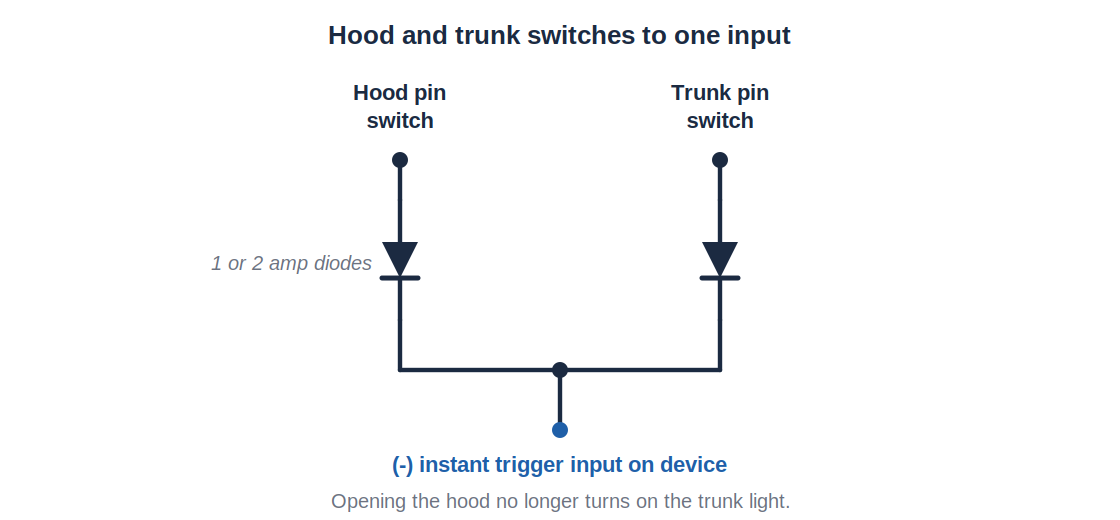
Same trick for hood and trunk pins. Without diodes, opening the hood can turn on the trunk light, because the two circuits are now tied together. With diodes, each switch triggers the device and stays isolated from the other.
Fleet uses for this: door open reporting, tailgate or rear door monitoring on box trucks, PTO engaged inputs, any time you want "any of these" to trigger "this one input."
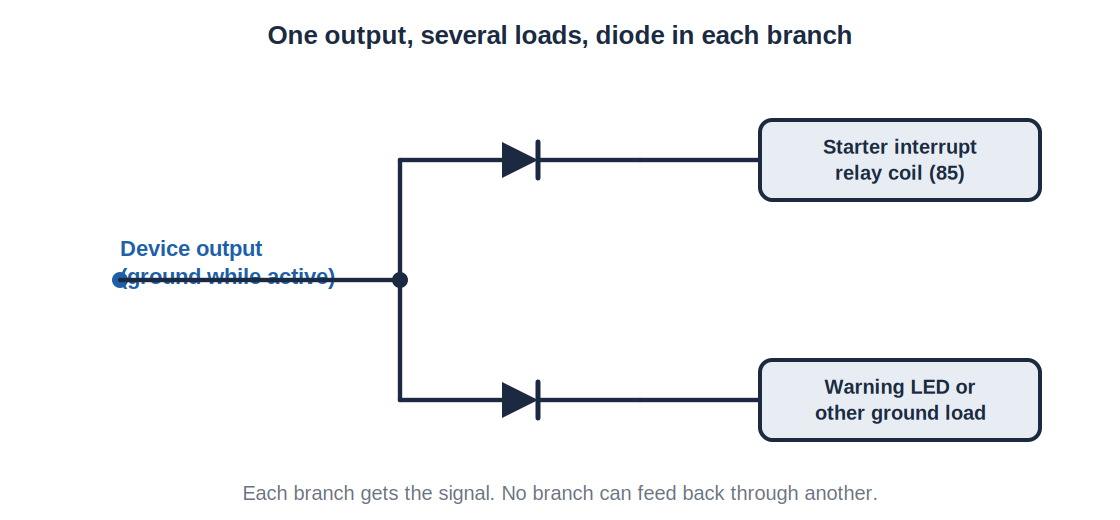
The reverse situation. One device output needs to drive several things: a starter interrupt relay and a warning LED, for example. Put a diode in each branch. Each load gets the signal, and nothing on one branch can feed back through another branch.
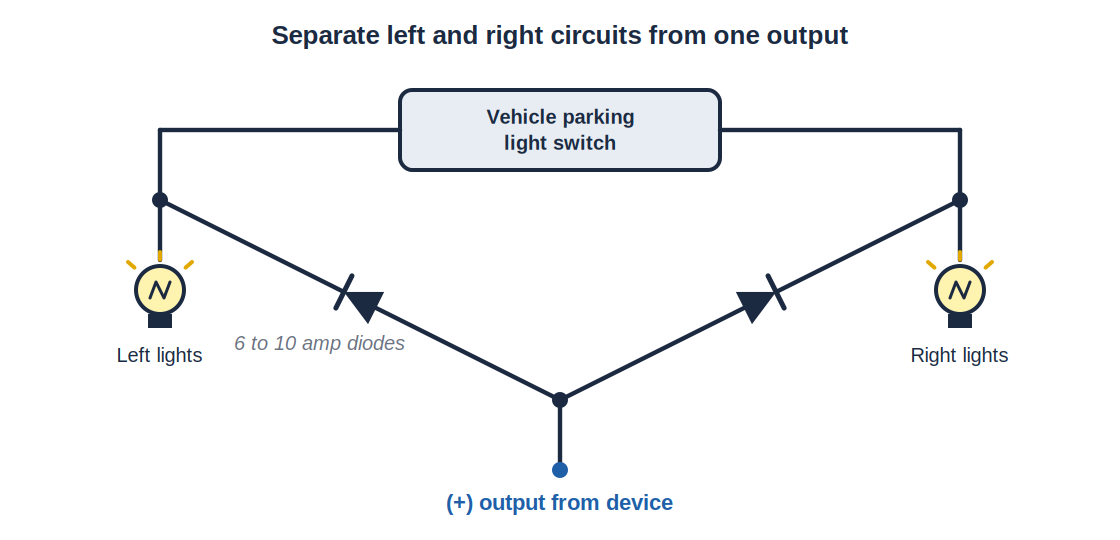
Vehicles with separate left and right parking light circuits are the textbook example. One positive output, two diodes, two circuits, no back-feed. Because parking lights draw real current, this one needs 6 to 10 amp diodes.
When a relay coil de-energizes, it kicks back a voltage spike that can damage the output of the device driving it. A diode across the coil (cathode/stripe toward the positive side, pins 85 and 86) absorbs that spike. Some relays come with this diode built in. When you're not sure, add one. It costs almost nothing and saves the output.
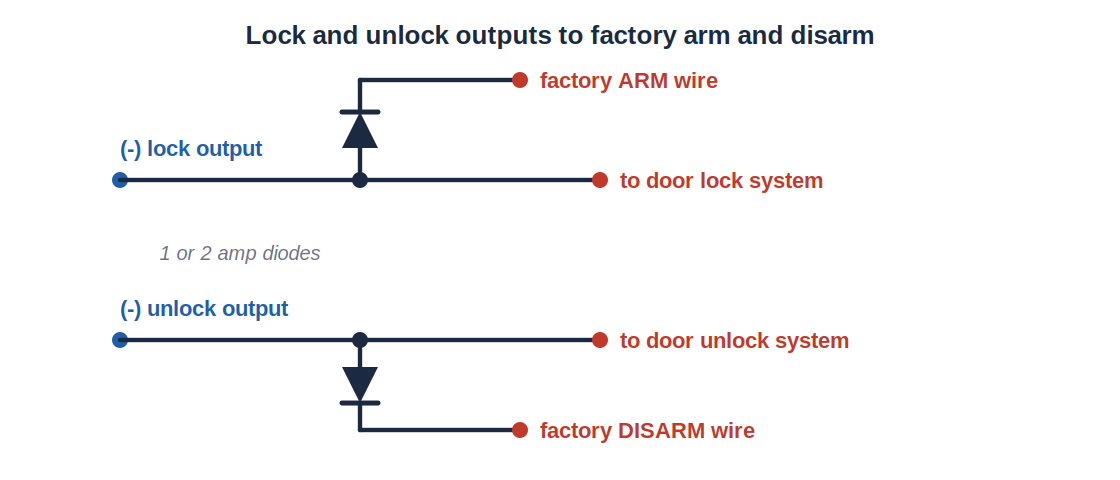
Some vehicles' factory security or immobilizer needs to be told when doors are locked or unlocked by an aftermarket device. Diodes in the lock and unlock lines let a device's negative outputs reach the factory arm and disarm wires while keeping the factory circuit from pulsing the door locks on its own. Note that many factory systems arm passively and have no arm wire at all.
Rather have us do it? We install GPS, dash cams and telematics across Georgia, South Carolina, North Carolina, Tennessee, Virginia, Alabama, Florida and Mississippi, at your yard. Get a free quote or call/text 803-513-1009.
This information is provided as a guide. Verify every circuit with a digital multimeter before connecting to it. Proper installation is the responsibility of the installer.
We install GPS, dash cams and telematics across GA, SC, NC, TN, VA, AL, FL & MS — at your yard, on your schedule.