
Built by Installers, for Installers
A digital multimeter is the cheapest way to look smart. It is also the way you avoid a callback. This lesson covers the three readings every install needs and the one place on every vehicle where you leave the meter in the bag.
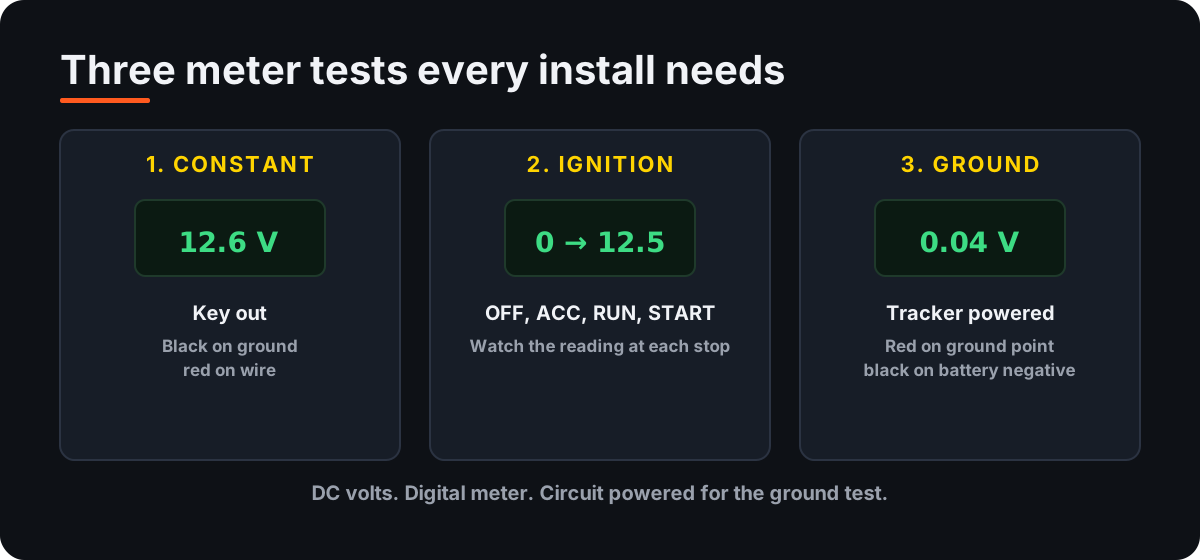
That is it. The whole course so far fits in three tests. If you do these on every vehicle, you catch the faults before the customer does.
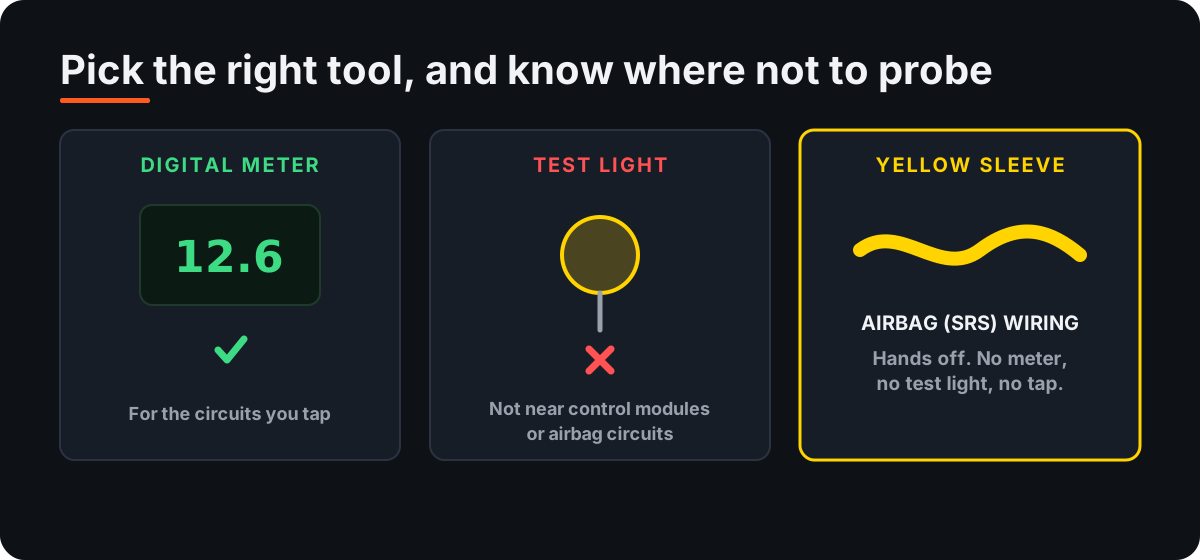
A test light only tells you there is something there. It cannot tell you 12.6 volts from 8, and it can draw enough current to upset a control module on circuits that were meant to carry almost none. A digital meter reads the number and draws very little.
Airbag wiring. It is called the SRS, short for supplemental restraint system, and its wires are wrapped in a bright yellow outer sleeve. The trouble is simple: SRS circuits are built to fire a squib that deploys a bag, and a wrong probe or a wrong current in the wrong place is how somebody gets hurt. Logistimatics' hardwire guide tells installers to leave yellow connectors alone. Tesla's service manual SRS precautions go further, saying not to use a multimeter or other general-purpose test equipment on SRS components.
The rule is easy and has no exceptions: if the sleeve is yellow, you do not probe it, tap it, tape to it or pull it. A good source of power is never under a yellow sleeve. Find it at the fuse panel or a power distribution point.
DC volts on a digital multimeter. For a voltage drop test the circuit has to be powered, so use DC volts rather than the ohms setting.
SRS (airbag) wiring uses a yellow outer sleeve and often yellow connectors. Do not probe, tap or cut it.
Use a digital meter instead. A test light draws more current and can upset sensitive circuits. Never use one on SRS wiring.
Built by Installers, for Installers.
Constant. Ignition. Ground. API Signal.
Join the API Signal installer network and find install work near you. We install GPS, dash cams and telematics across GA, SC, NC, TN, VA, AL, FL and MS.