
Built by Installers, for Installers
Power and ignition get all the attention. The ground gets a ring terminal and a prayer. Then the tracker reboots on rough roads, drops off the map on cold mornings, or reads fine all week and fails on Friday. Very often the device is innocent. The ground is guilty, and it is the one wire many installers never measure.
A ground is half of the circuit. Current goes out on the power wire and has to come back through the ground path to the battery. If that path has resistance, the device sees a lower voltage and the loss turns into heat or dropouts. The tricky part is that a weak ground usually works on the bench with the key out and nothing drawing power. It misbehaves only under load, vibration or temperature swings, which is why it shows up as an intermittent fault that is hard to catch.
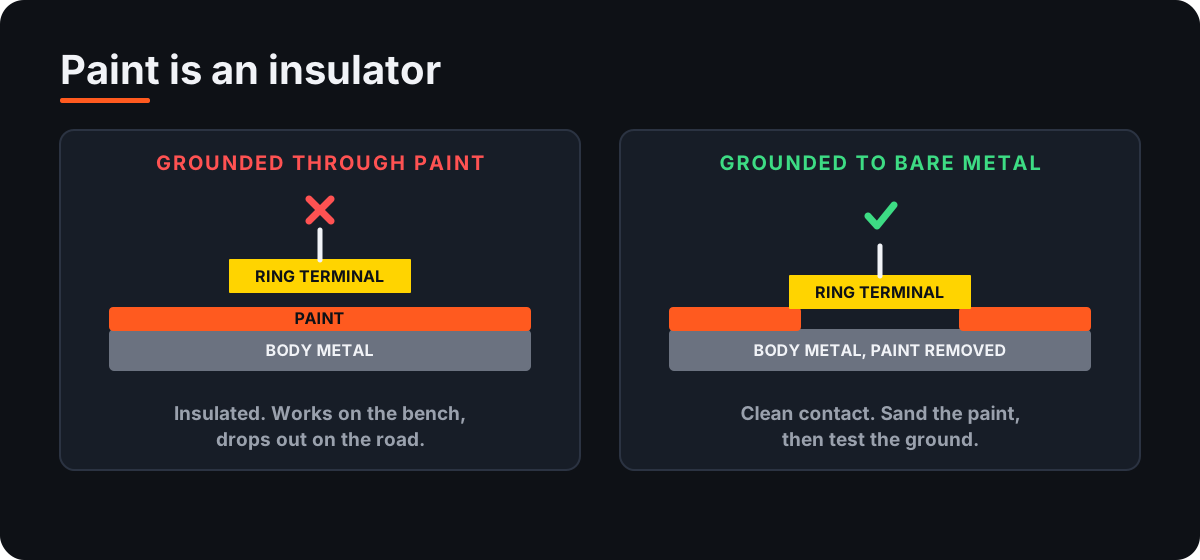
The classic mistake is a ring terminal under a bolt that goes through a painted bracket. It looks like metal, it feels solid and it may even read well on a quick check. Logistimatics' hardwire guide says it directly: paint is an insulator, so a ground through paint is a ground that drops out. Geotab's harness guide asks for the same thing from the other direction, telling installers to remove paint or corrosion before they ground.
Powder coat counts as paint. So does rust converter, undercoating and the clear coat on a bracket. Pick a factory ground bolt on bare metal where a bundle of black wires already lands, or sand a spot down to bright metal, and then test it.
You do not measure a ground with an ohm meter. You measure it with the circuit running, because a weak ground only shows itself while current flows. This is called a voltage drop test, and it takes less than a minute.
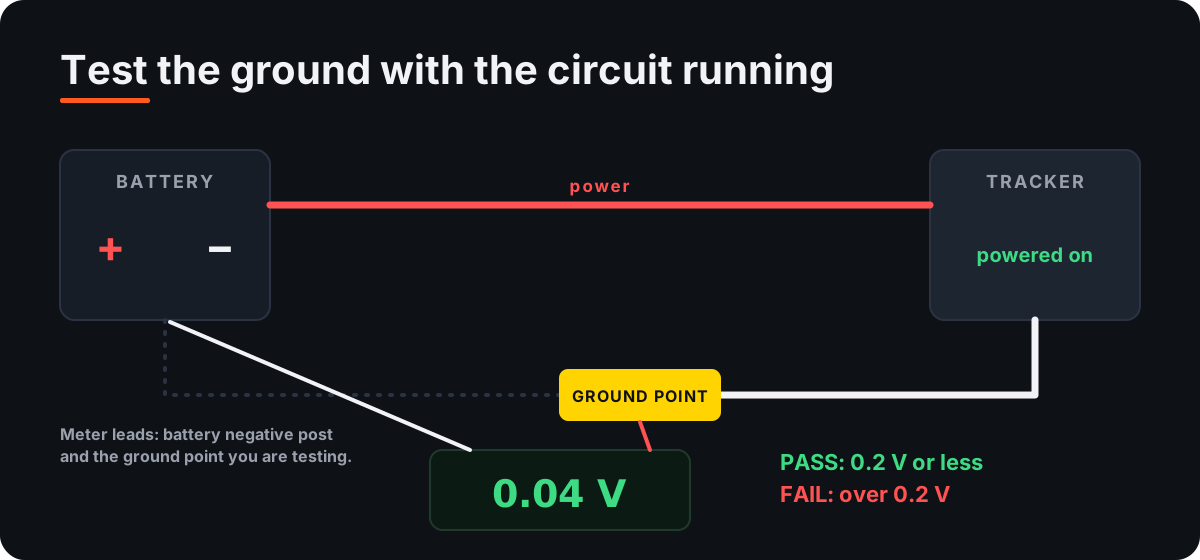
Fluke, a leading maker of test meters, publishes limits for starter circuits that make a handy yardstick: about 0.2 volts or less on the ground side and about 0.3 volts on the power side. Fluke lists corrosion, loose terminals and damaged cables as the usual causes when the number runs high. Use those figures as a conservative guide for your own install, and aim for far below them.
One more rule: if the meter reads close to battery voltage itself, that is not a "weak" ground. It is an open one. Nothing is connected. Check the terminal and the bolt.
Ready to see if you can spot a bad ground under the clock? Play the Install Bench. Every level hides at least one painted or rusty ground.
Do a voltage drop test. Power the device, set a meter to DC volts, put one lead on the battery negative post and the other on the device ground point, and read the number. Fluke lists about 0.2 V or less on the ground side of a starter circuit as a good yardstick.
Not without removing the paint. Paint is an insulator. Use a factory ground bolt on bare metal or sand the contact area to clean metal, then test the result.
Corrosion, loose terminals, damaged cables and paint or coatings between the terminal and the metal.
Built by Installers, for Installers.
Constant. Ignition. Ground. API Signal.
Join the API Signal installer network and find install work near you. We install GPS, dash cams and telematics across GA, SC, NC, TN, VA, AL, FL and MS.