
Built by Installers, for Installers
The ignition wire is the one that decides whether your customer's reports are right or wrong. It tells the device when the engine is on. Pick the wrong wire and the reports fill up with trips that never happened, idle time that is made up and drivers who get blamed for things they did not do. Many of those mistakes come from one confusion: accessory is not ignition.
A key switch has four stops: OFF, ACC, RUN and START. Different wires wake up at different stops, and that is the whole game.
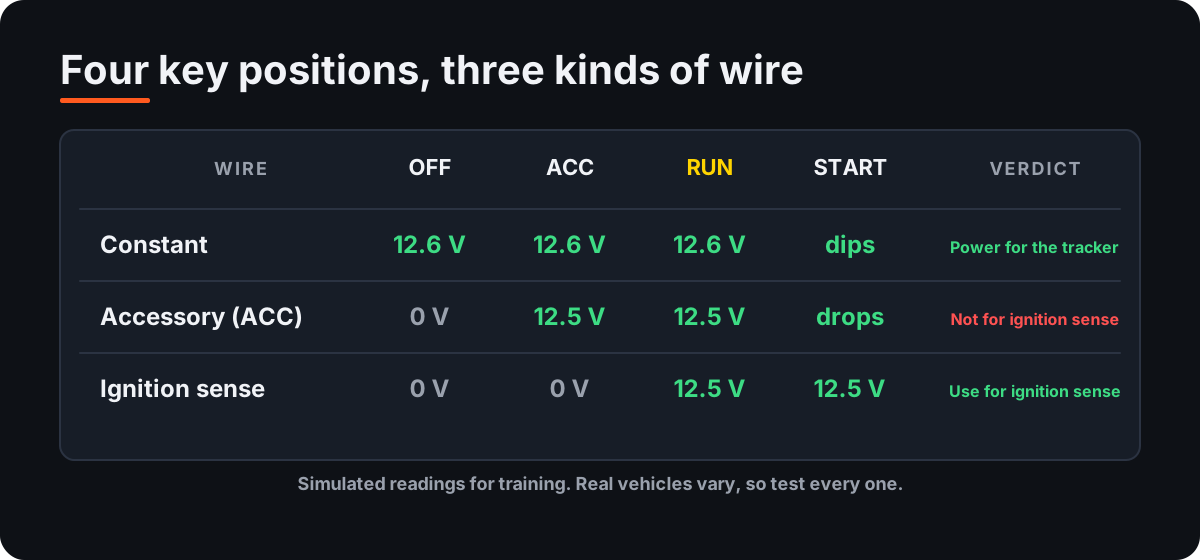
GPS Insight's install guide asks for exactly this: an ignition source with at least 12 volts DC with the key on, and 0 volts DC with the key off or in accessory. That is a common rule across the industry. Zero in OFF, zero in ACC, battery voltage in RUN.
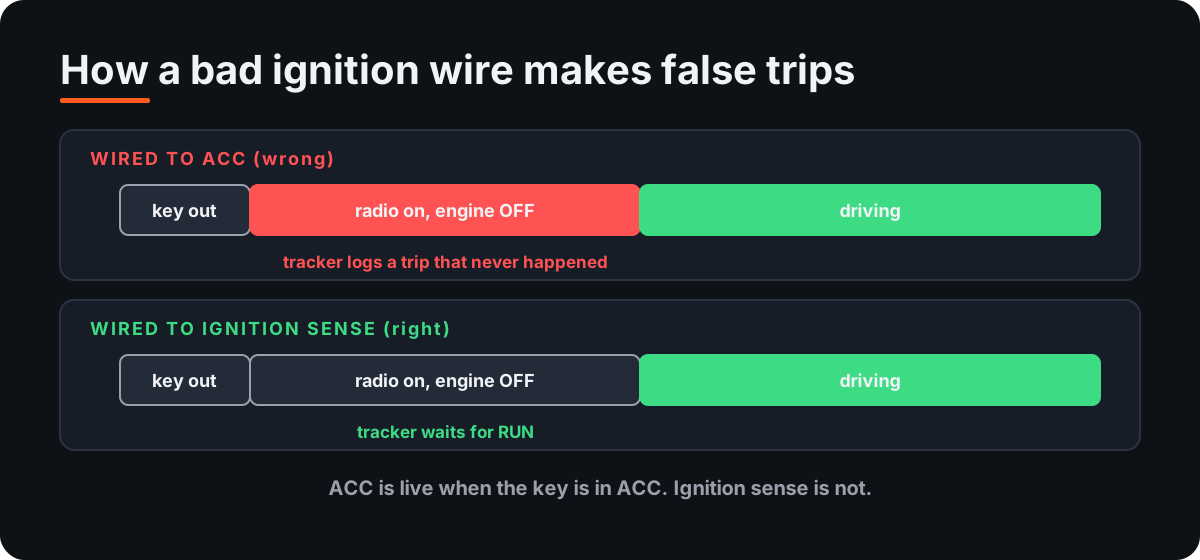
The device has no idea what an engine is. It sees voltage on a wire and treats that as "ignition on." Wire it to ACC, and every minute a driver spends in a parked truck with the radio on becomes a trip. The report shows movement or idle hours that never happened. The fleet manager sees a driver "running" for two hours at lunch, calls the driver, and now your install is the villain.
Do the ACC position on purpose. Many installers jump from OFF to RUN and skip it, and ACC is the stop that separates a good wire from a bad one. Turn the key only as far as the first click, read, then go on. Read the START number as well, because a good ignition wire may dip or flicker as the starter pulls the battery down.
First, a wire that looks right when the engine is running can still be wrong. Some circuits stay live for a while after the key goes off, to run a fan or a module. Run the test, then take the key out and watch the wire for a minute. It should fall to zero and stay there. Second, do not trust a wire color you read in a forum or a chart without testing. Colors change across years and trims, and a chart is a good place to start the search, not to end it.
Want to try it on a vehicle with decoy wires and a clock running? Open the Virtual Install Bench. Level 1 is built around exactly this lesson.
An ignition sense (switched ignition) wire has 0 volts in OFF and ACC and battery voltage in RUN. A tracker uses it to know when the engine is on.
Accessory is live in ACC and RUN and powers things like the radio. Ignition sense is live only in RUN. Using an accessory wire for ignition sense creates false trips and idle time.
Test candidate wires with a digital meter at OFF, ACC, RUN and START. The one that reads 0 V, 0 V, battery voltage, battery voltage is your ignition sense wire.
Built by Installers, for Installers.
Constant. Ignition. Ground. API Signal.
Join the API Signal installer network and find install work near you. We install GPS, dash cams and telematics across GA, SC, NC, TN, VA, AL, FL and MS.