
Built by Installers, for Installers
Most trackers, dash cams and telematics boxes need three things from the vehicle: constant power, an ignition signal and a ground. Get one wrong and the device still lights up on the bench. It fails on the road, a week later, in front of the customer. Start with the easy one. Constant power is the wire that stays live no matter what the key is doing, and it is a wire installers often trust too fast.
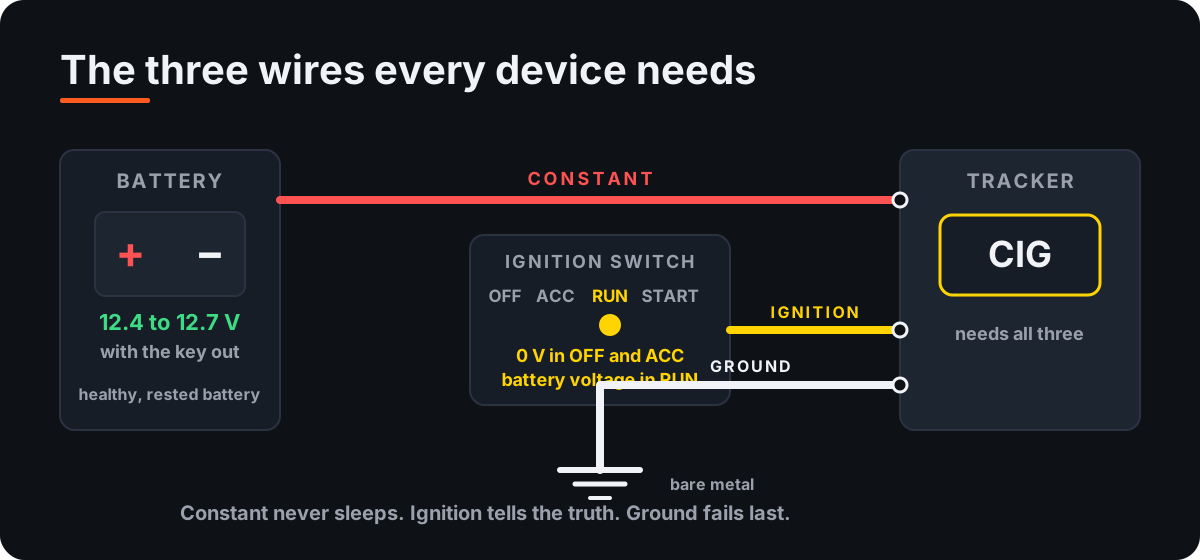
A constant wire is connected to the battery side of the electrical system through a fuse, with no switch in between. It has battery voltage with the key out, with the key in ACC, in RUN and in START. Geotab, a major telematics maker, put it plainly in their 3-wire harness guide: constant power must be connected to a true battery source that is live at all times.
"True battery source" is the part to underline. A wire can read 12 volts and still not be constant. It might be live only because the key is in, or because a door was just opened, or because a module woke up for ten minutes after you closed the door. A reading means nothing until you have taken it at every key position.
The fastest place to find constant power is the interior fuse panel. It is also where installers get burned. Fuse slots are not labeled with how they are switched, and the same slot position can be constant on one trim and switched on the next. Cavity labels, diagrams on the panel cover and a quick online chart are starting points. They are not proof. The meter is the proof.
Here is the sorting rule in one line: if it reads battery voltage with the key out and keeps reading it as you walk the key through ACC, RUN and START, it is a candidate for constant. If it drops to zero anywhere, it is not constant and you move on.
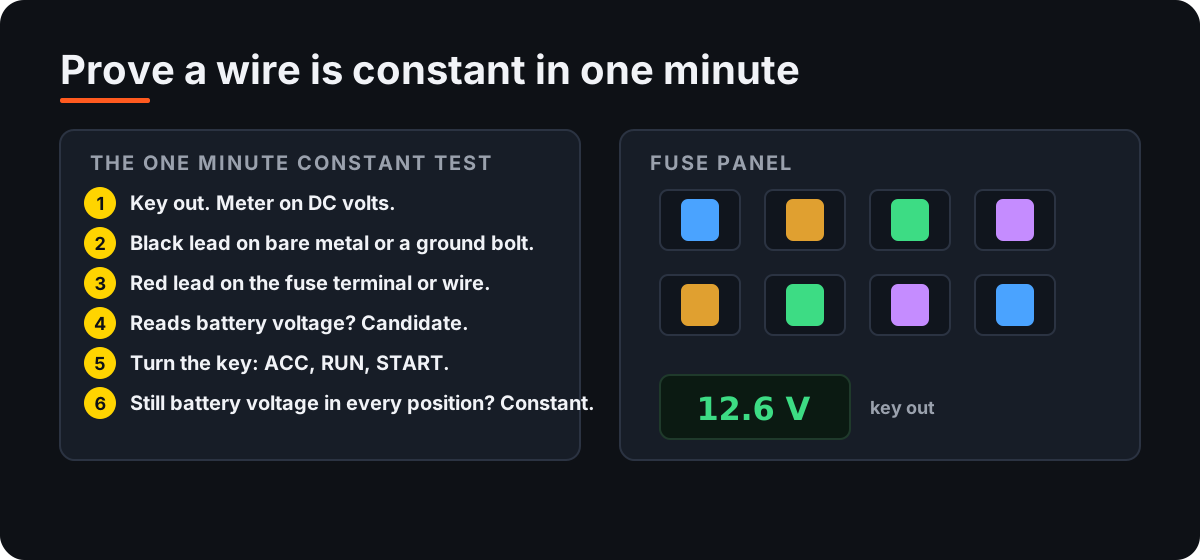
Two small details save real grief. First, check the battery itself before you judge a reading. A rested, healthy 12 volt battery sits around 12.4 to 12.7 volts with the key out, so a reading in that range is what a good constant wire shows. Second, expect a dip in START. Cranking pulls the battery down hard, so a good constant wire may sag for a second and recover. A wire that goes to zero is a different animal from a wire that sags.
A bad constant wire does not announce itself. The device powers up, the light goes green, the customer signs, you leave. Then the vehicle sits overnight and the device goes dark. For a dash cam with parking mode, a bad constant wire means no recording when something happens to the car while it is parked, which is the exact moment the customer bought it for. The callback is yours, and so is the reputation.
Five questions. You earn 5 points for each right answer, and your best score is saved on this device. It takes about two minutes.
A constant (always hot) wire has battery voltage with the key out and in every key position. It reaches the battery through a fuse with no switch in the way, and it keeps a tracker or dash cam alive while the vehicle is parked.
Set a digital meter to DC volts, put the black lead on bare metal, put the red lead on the wire or fuse terminal, and read it with the key out, then at ACC, RUN and START. Battery voltage at every stop means constant.
Use it as a starting point. Switching can vary by trim and year, so confirm every wire with a meter before you tap it.
Built by Installers, for Installers.
Constant. Ignition. Ground. API Signal.
Join the API Signal installer network and find install work near you. We install GPS, dash cams and telematics across GA, SC, NC, TN, VA, AL, FL and MS.