
A tracker needs two things from a vehicle: power, and a way to know what the vehicle is doing. The port it uses decides how the install goes, how it fails and how you test it. Light duty vehicles all use one port, the OBD2. Heavy duty vehicles and equipment use many different ones. This page lists them all.
In our own installs, roughly three in four use a Y-split harness. That is our estimate from the field, not an industry statistic. Three-wire hardwire is the minority now, and we still teach it first because it is where the mistakes are most expensive.
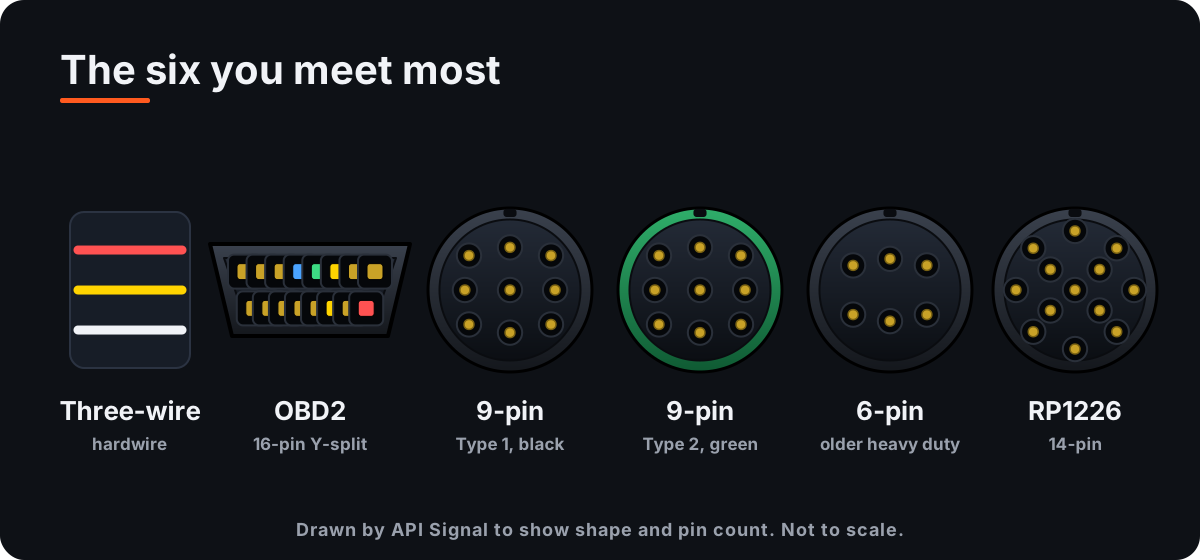
| If it is a... | The port is... | Jump to |
|---|---|---|
| Car, van, pickup (light duty) | OBD2, 16 pins, D shaped | Light duty |
| Semi or heavy truck, newer | 9-pin round (black or green), or 14-pin RP1226 | Heavy duty trucks |
| Semi or heavy truck, older | 6-pin round | Heavy duty trucks |
| Volvo or Mack heavy truck | 13-pin, or a 24 V OBD style port | Heavy duty trucks |
| Hino, Isuzu, Fuso, Sprinter, Europe, Latin America | Maker ports and the 12-pin FMS | Medium duty and global |
| Excavator, loader, skid steer, tractor, off-road | Cat, Komatsu, John Deere, Bobcat, Deutz and others | Equipment |
| Anything with no usable port | Three wires, tested | Three-wire |
Short on time? Count the pins, look at the shape and the color. That settles it more often than a spec sheet does.
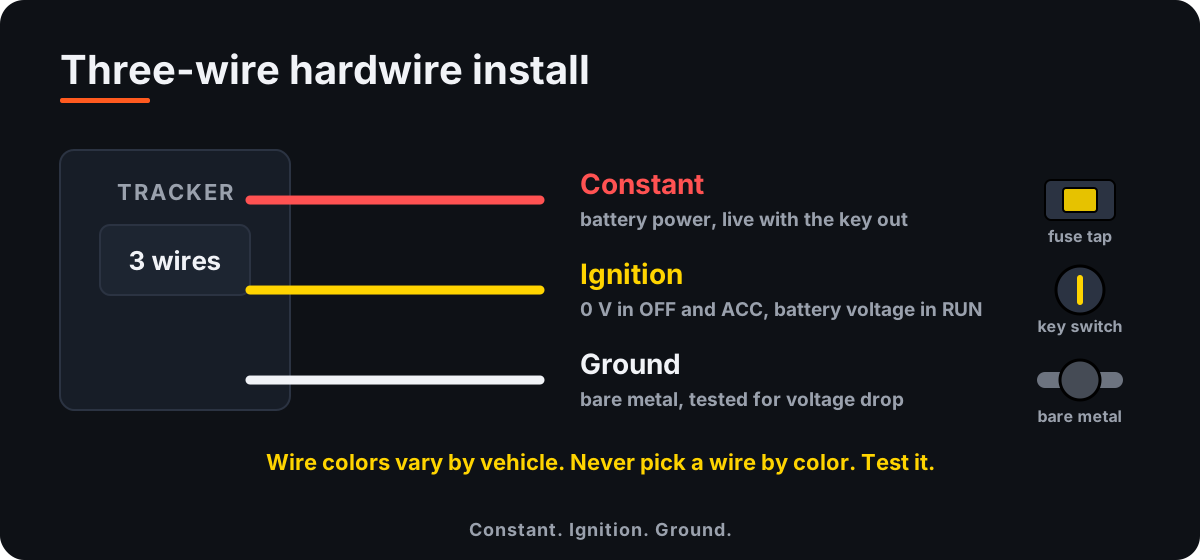
This is the install most trackers used to get, and it works on anything with a battery. Constant power from a source that stays live with the key out, an ignition signal that is dead in OFF and ACC and live in RUN, and a ground on bare metal. Nothing is plugged in anywhere, so nothing protects you from guessing wrong.
Where it bites: the ignition wire. A device wired to an accessory circuit reports false idling and false trips, and we see it all the time because most people never meter for a true ignition. GPS Insight's guide asks for at least 12 V with the key On and 0 V in Off or Accessory. Meter it.
See more: the free Wiring Basics course →
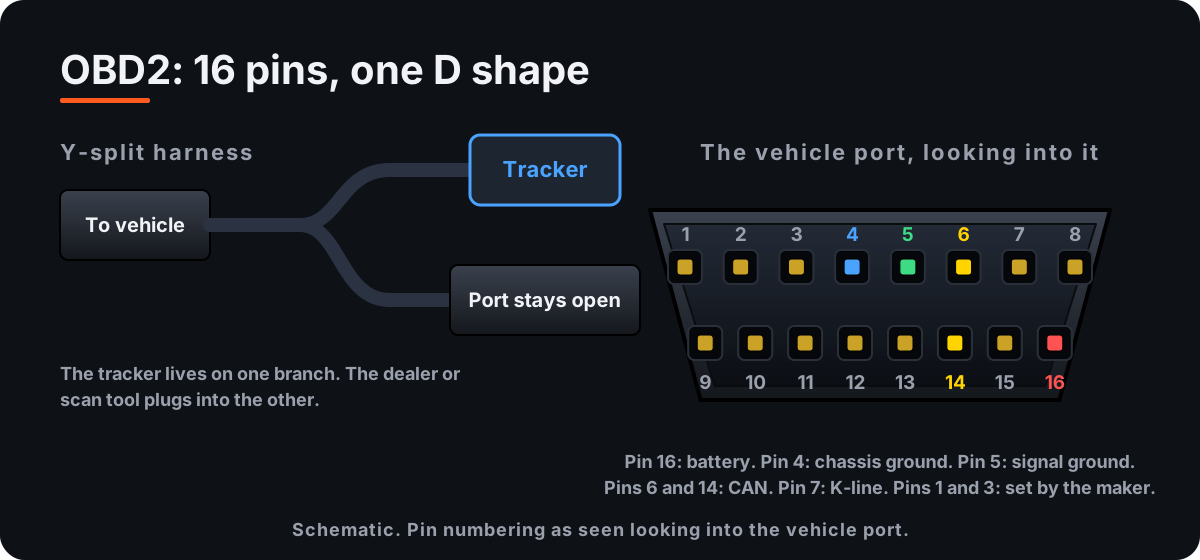
The OBD2 port is the light duty port. Every car, van and pickup has one. A Y-split harness plugs in, then divides: one branch to the tracker, one that reopens the port for a scan tool. There is no separate ignition wire to find. The device takes power from the port and reads vehicle data.
| Pin | What it is |
|---|---|
| 16 | Battery positive (12 V, or 24 V on some heavy vehicles) |
| 4 | Chassis ground |
| 5 | Signal ground |
| 6 and 14 | CAN high and CAN low |
| 7 | K-line |
| 2 and 10 | J1850 bus |
| 1 and 3 | Set by the vehicle maker |
Pin assignments per the published J1962 pinout on pinouts.ru. Where a maker uses its own pins, the vehicle's service information wins.
Where it bites: the harness itself. Geotab says to use only approved harnesses, because look-alikes carry a fire and injury risk, and to keep the total harness length under 2 meters. Its flat extension harness for a recessed port leaves pins 1, 3 and 11 unpopulated, which can limit engine data. Two T-harnesses cannot be chained together.
Older light duty: some older GM, Ford and Freightliner vehicles use the ALDL port instead. Geotab carries a special order harness for it (HRN-BD16S5).
Heavy trucks with an OBD style port: a few heavy trucks do put a 16-pin OBD style port in the cab, but at 24 V. Geotab lists Mack from 2013 to 2018 and Volvo from 2013 on, plus some Mercedes and European Volvo trucks. These take a heavy duty OBD harness (HRN-GS16K2-HD), not the light duty one.
See more: connecting to CAN bus and OBD2 →
See more: keeping a tracker from being unplugged →
Heavy duty trucks do not use the light duty OBD2 port for the tracker. These are the ones you will meet on semis and other big trucks.
| Connector | Looks like | Typical vehicle | Data |
|---|---|---|---|
| 9-pin Type 1 | Round, black, 9 pins | Older style J1939 trucks | J1939 CAN, 250 kbps |
| 9-pin Type 2 | Round, green, 9 pins | Newer J1939 trucks | J1939 CAN, 500 kbps |
| 6-pin | Round, 6 pins | Older semis and heavy trucks | J1708 / J1587, 9,600 bps |
| 14-pin RP1226 | Round, 14 pins, behind a panel | Newer heavy trucks | CAN, as far as the maker allows |
| Volvo / Mack 13-pin | Round, 13 pins | Volvo and Mack heavy trucks | 12 V or 24 V, maker specific |
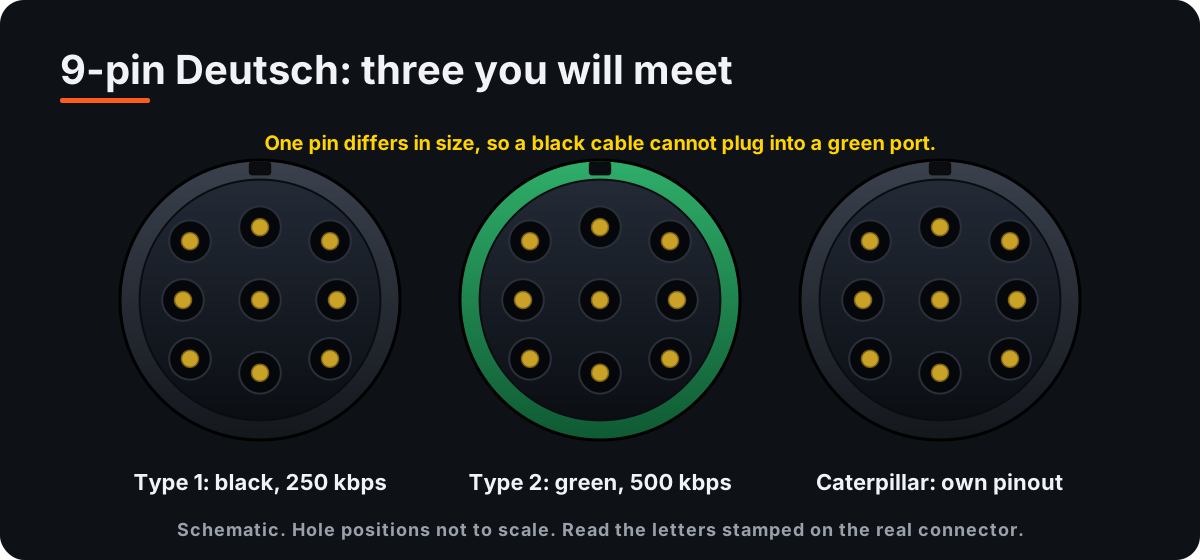
The standard heavy duty port, also called the J1939 diagnostic connector. It shows up on semis, and the same 9-pin plug also turns up on heavy equipment. A 9-pin Y-split works like the OBD2 one: the tracker gets power and data, and the port stays free.
| Pin | Function |
|---|---|
| A | Battery negative (ground) |
| B | Battery positive |
| C and D | CAN high and CAN low |
| E | CAN shield |
| F and G | J1708 positive and negative |
| H and J | Maker use, or a second CAN network |
Pinout per Copperhill Technologies' published J1939 9-pin cable data. Check the letters stamped on the connector.
Black or green? Type 1 is the original black connector, running J1939 at 250 kbps. Type 2 is the green one, built for the J1939-14 standard and 500 kbps. A Type 2 cable fits both ports. A Type 1 cable fits only a Type 1 port, because one pin on the green port is deliberately different and blocks it. That keeps older 250 kbps gear off a 500 kbps network.
Sources disagree on when green took over: one traces Type 2 to a 2013 and 2014 rollout, another puts it on trucks from 2016. That is why you look at the connector, not the calendar.
Where it bites: assuming. A diagnostics supplier notes that some 2016 and newer Peterbilt, Kenworth and Volvo trucks put powertrain traffic on a different CAN channel than standard tools expect. If a tracker reads no engine data on one of those, ask the device maker before you blame the harness.
See more: choosing the right 9-pin harness →
See more: every Geotab harness and part number →
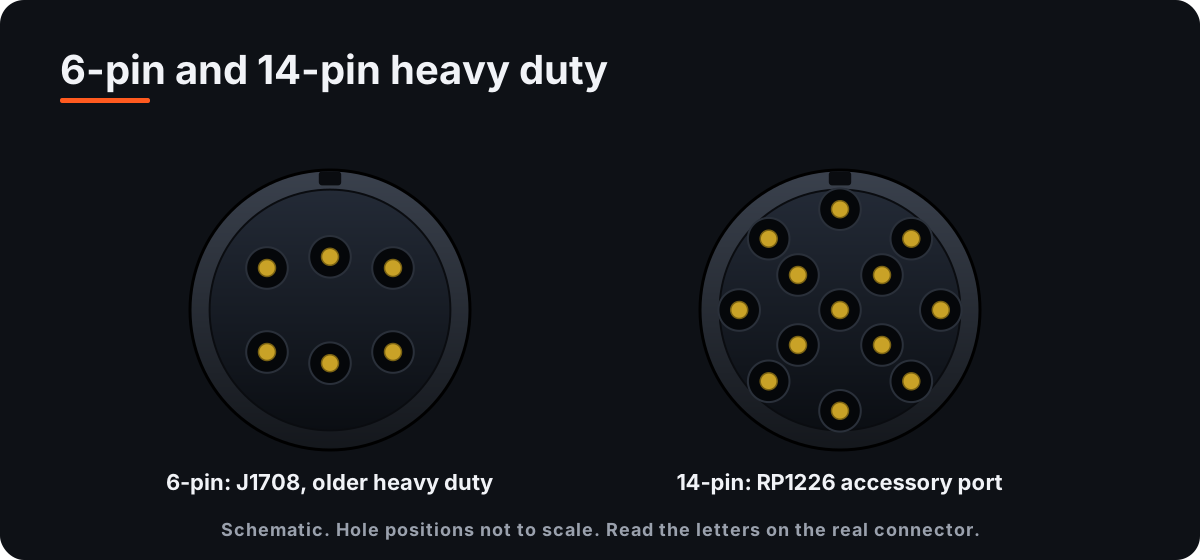
The older heavy duty port, standard on trucks from about 1996 to 2001 and still on plenty of older semis and older heavy duty vehicles. It carries the J1708 data link at 9,600 bits per second. That is not CAN, so a device with only CAN inputs cannot read it. It needs a device or interface that supports J1708.
| Pin | Function |
|---|---|
| A | J1708 data (+) |
| B | J1708 data (-) |
| C | Unswitched +12 V |
| E | Ground |
| D and F | Not assigned |
Pinout per pinouts.ru for the 6-pin Deutsch J1587 connector.
Where it bites: model year is a poor guide. Two identical trucks built the same month can differ, with one having the legacy data link switched off in software. Many 9-pin ports from about 2001 on carry J1708 as well, for backward compatibility. Geotab makes straight and T-style 6-pin harnesses (HRN-DS06S4, HRN-DS06T2-A), so an old truck is not a reason to skip tracking it.
A newer accessory port for heavy duty trucks, put there so telematics devices, ELDs and dash cams have somewhere to plug in without touching the diagnostic port. It is usually tucked behind a panel and needs its own cable (Geotab: HRN-CS14T2 or HRN-CS14S21). Samsara recommends it for 2018 and newer heavy duty trucks, and one industry source describes it as standard on 2021 and newer trucks.
Where it bites: the maker decides what data the port exposes. Some give unrestricted CAN access, others filter through a gateway. Before you count on it, confirm odometer, VIN, speed, RPM and engine hours actually come through. It is not on every truck, so plan for a 9-pin as well. We have not verified the pin assignments, so we are not printing them.
Volvo and Mack heavy trucks get their own harnesses. Geotab lists a 13-pin Volvo and Mack harness for 12 V and 24 V (HRN-CG13S1-A). For North America it uses a base harness (HRN-CM24Y1-A) with a model year adapter: HRN-CE10K2 for Volvo and Mack from 2019, and HRN-CK10K2 for Mack from 2018 and older. Volvo trucks in Latin America and Europe use HRN-CE04A4. Samsara's Volvo and Mack guide has the installer move the original OBD port out of the way, mount a spare in its place so diagnostics still work, and plug the cable into the vehicle side.
Where it bites: Volvo construction equipment can run its ignition circuit through its own CareTrack module. Tap the fuse panel for ignition and leave that harness alone.
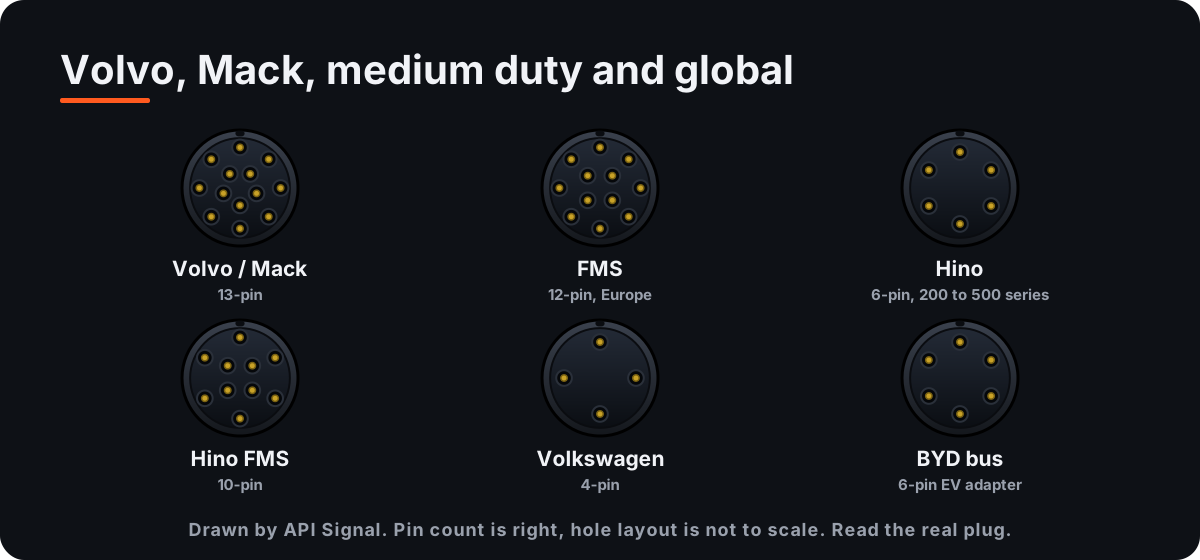
Medium duty trucks and vehicles outside North America often have their own plug. These stay in the overview as plain reference. Part numbers are Geotab's, from our harness list.
| Connector | Where | Notes |
|---|---|---|
| 12-pin FMS | European heavy trucks, Mercedes and Volvo with an FMS module | Fleet Management Standard port (HRN-ES12S1) |
| Hino 6-pin | Hino 200 to 500 series, 2014 to 2018 | HRN-CH06A2 |
| Hino 10-pin FMS | Hino | HRN-CH10A2 |
| Isuzu FMS | Isuzu diesel, 2017 and newer, optional port | HRN-CI04A2 |
| Mitsubishi Fuso and medium duty engines | Extra connector on an OBD2 harness | HRN-BU16Y5 |
| Mercedes Sprinter PSM | 907 chassis | HRN-CP04K2, HRN-UP21Y2 |
| Volkswagen 4-pin | Volkswagen heavy duty, Latin America and Africa | HRN-CG04T3 |
| BYD 6-pin EV adapter | BYD electric buses, Latin America | HRN-BD06A1 |
| Peugeot, Citroen, Opel, Vauxhall | Europe | HRN-BD06A12 |
| Fiat / Chrysler engine data | Latin America | HRN-BF11A1 |
| Mercedes eActros power | Electric heavy trucks | HRN-EE06K3 |
Tesla vehicles use their own connectors by model and year. Geotab lists six Tesla harnesses, so match the model and year exactly.
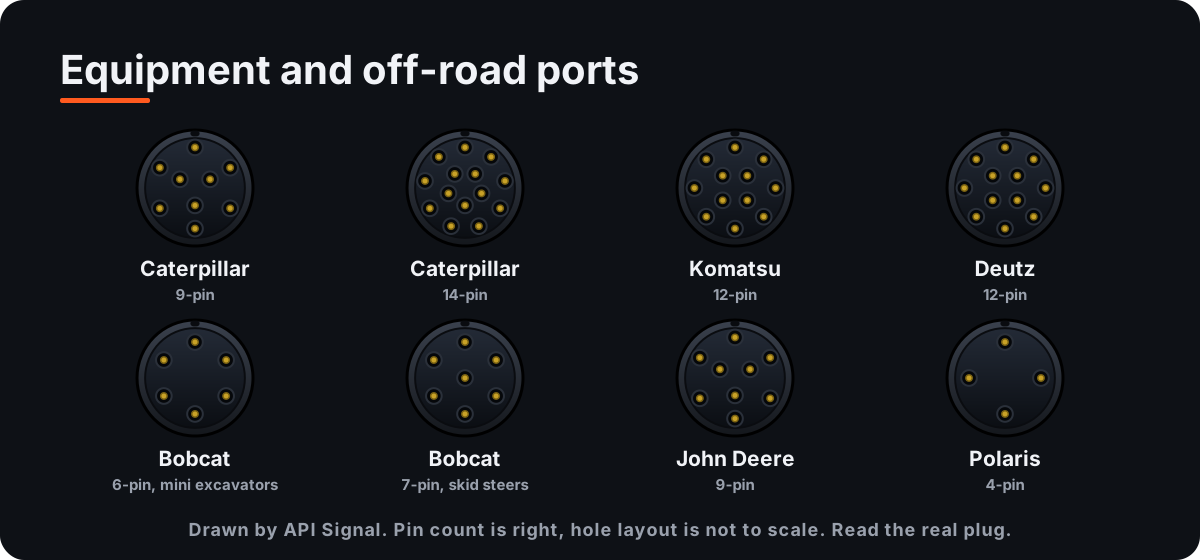
Excavators, loaders, skid steers, tractors and utility vehicles are their own world. Some have a round diagnostic plug, some have a plug only the maker uses, and some have nothing at all. Here is what we have found, brand by brand.
| Brand | Connector | Notes |
|---|---|---|
| Caterpillar | 9-pin and 14-pin | The 9-pin is on many machines from about 2000. The 14-pin is on newer ones. Geotab: HRN-DC14T1 (14-pin, 2016 and newer) and HRN-RMRCA1 (Cat adapter for the rugged 9-pin kit) |
| Komatsu | 12-pin, and a J1939 port | 12-pin on Tier 4 machines from 2010 (HRN-RC12T2). A J1939 port sits under the operator's seat on the right side |
| John Deere | 9-pin | A JDLink factory harness may already be on the machine. Check before you add a second device |
| Bobcat | 6-pin and 7-pin | 6-pin on mini excavators (HRN-RL06T1). 7-pin on skid steers from 2000 (HRN-RL07T1) |
| Deutz | 12-pin | Off-road engines (HRN-RL12K2) |
| Kubota | Gas and diesel engine harness | HRN-RZ04T4 |
| Polaris | Interface harness | HRN-RD04S1 |
| Ford EDI tug engine | T-harness for ground support equipment | HRN-RZ04T41 |
| Hitachi, Cummins | J1939 Type 1 or Type 2 | The machine's J1939 port is the standard 9-pin black or green |
A Cat 9-pin looks like the J1939 plug, but it is not always wired like one. Technicians on a heavy equipment forum report pin A as battery positive, B as battery negative, D and E as the Cat Data Link, and F and G as J1939. That is from forum posts, not a Cat manual, and the same thread notes some machines are wired differently. Treat the real plug and the machine's service manual as the authority. New skid steers can also use a nut-style Cat 9-pin, so confirm the plug before you order a harness.
Sources disagree on the exact years for the 9-pin and the 14-pin, so we are not giving a year cutoff for Cat. Geotab names its 14-pin harness for 2016 and newer, and other sources give 2017 and later.
Equipment often has no usable port, so a three-wire install is common. These are the ignition access points one installation guide gives. Always meter it, as on any vehicle.
| Brand | Where to look |
|---|---|
| Caterpillar | Fuse panel under the right armrest, ACC-2 slot |
| John Deere | Flip-down fuse panel above the operator's left shoulder, IGN or KEY slots |
| Komatsu | Circuit behind the instrument cluster, reached by removing the trim ring |
| Volvo | Fuse panel, not the CareTrack harness |
| Older machines | Behind the key switch |
Where it bites: on a John Deere 324K, Geotab's notes say to cut and cap pins F and G of the 9-pin. Machines can need something different from the brand's other models, so read the guide for the exact machine.
Rugged and off-road installs also use power and signal harnesses that have no vehicle connector. Geotab's rugged line includes:
| Harness | What it is for |
|---|---|
| Tri-pin (HRN-RW07T1) | Off-road machines with no diagnostic port |
| Three-wire with fuse kit (HRN-RW03K4-A) | Power, ignition and ground on rugged machines |
| Eight-wire with fuse kit (HRN-RW08K1) | Custom wiring when no connector is supported |
| Pulse (HRN-RW03K5) | Machines with no ignition or RPM signal |
| Differential (HRN-RW04K4) | Negative disconnect, oil pressure, negative ignition |
| OBD2 to rugged 12-pin (HRN-RS12S2) | Moving a rugged device onto an OBD style port |
| Battery disconnect bypass (HRN-RS12K1, HRN-BD16K1) | Keeping a device powered when the machine's disconnect is off |
See more: every Geotab harness and part number →
If it is a port we have not listed, send us a photo. Different ones turn up all the time.
A cable that plugs into the vehicle's diagnostic port and divides in two. One branch connects the tracker and the other reopens the port so a dealer or scan tool can still plug in.
No. A Y-split install has no separate ignition wire to find. The device takes power from the port and reads vehicle data. Only three-wire hardwire installs use constant, ignition and ground.
OBD2 is the light duty port. Heavy duty trucks use a round 9-pin or 6-pin connector, the 14-pin RP1226 accessory port, or a maker specific plug such as the Volvo and Mack 13-pin. A few heavy trucks also have a 24 V OBD style port that needs its own harness.
By color and by one pin. Type 1 is black and runs J1939 at 250 kbps. Type 2 is green and runs 500 kbps. A Type 2 cable fits both ports, but a Type 1 cable will not fit a Type 2 port.
A round 6-pin Deutsch connector carrying the J1708 data link, standard on heavy duty trucks from about 1996 to 2001 and still found on older semis and older heavy duty vehicles.
No. RP1226 is a separate 14-pin accessory port that needs its own cable. Many newer heavy duty trucks have both.
It depends on the brand. Caterpillar uses a 9-pin and a 14-pin, Komatsu a 12-pin, Bobcat a 6-pin on mini excavators and a 7-pin on skid steers, and John Deere a 9-pin. Some machines have no usable port and get a three-wire install.
Training and reference content only. Connectors and pin use vary by make, model and year, so follow the device manufacturer's installation guide and the vehicle's service information.
Built by Installers, for Installers.
Constant. Ignition. Ground. API Signal.
Send us a photo of the port area. We install GPS, dash cams and telematics across GA, SC, NC, TN, VA, AL, FL and MS.