
Built by Installers, for Installers
You have done the hard part. The wires are tested, fused, spliced and routed. The last ten minutes decide whether the install is finished or just not failed yet. Many callbacks come from skipping the closeout. It costs almost nothing, and it is the one habit that makes customers trust you with the next vehicle.
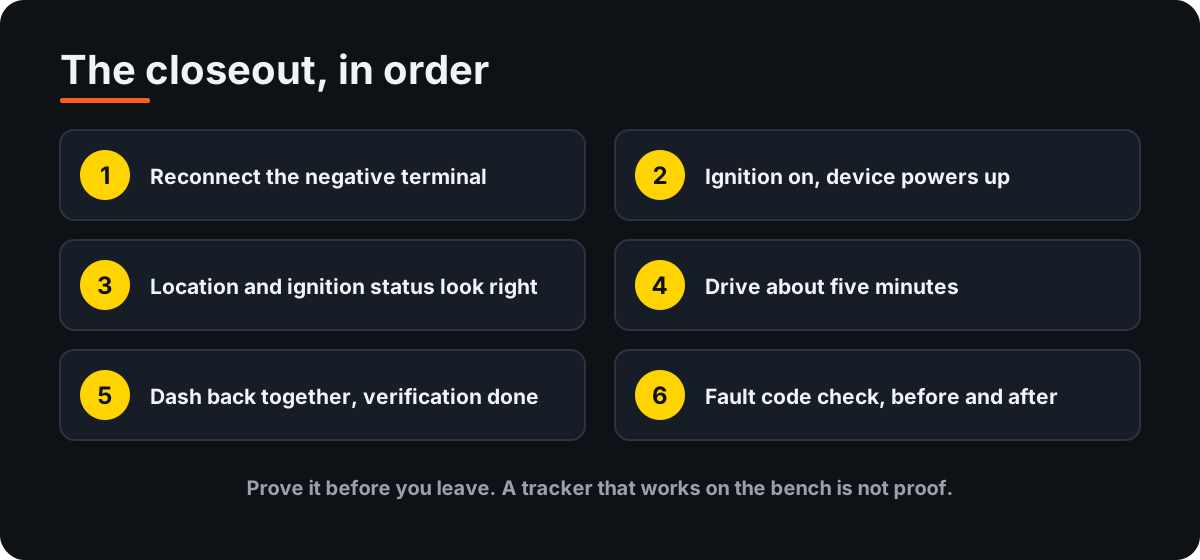
That is it. Six steps. The test drive is the one many installers skip, and it is the one that catches the dash panel that squashed a wire when it snapped back in.
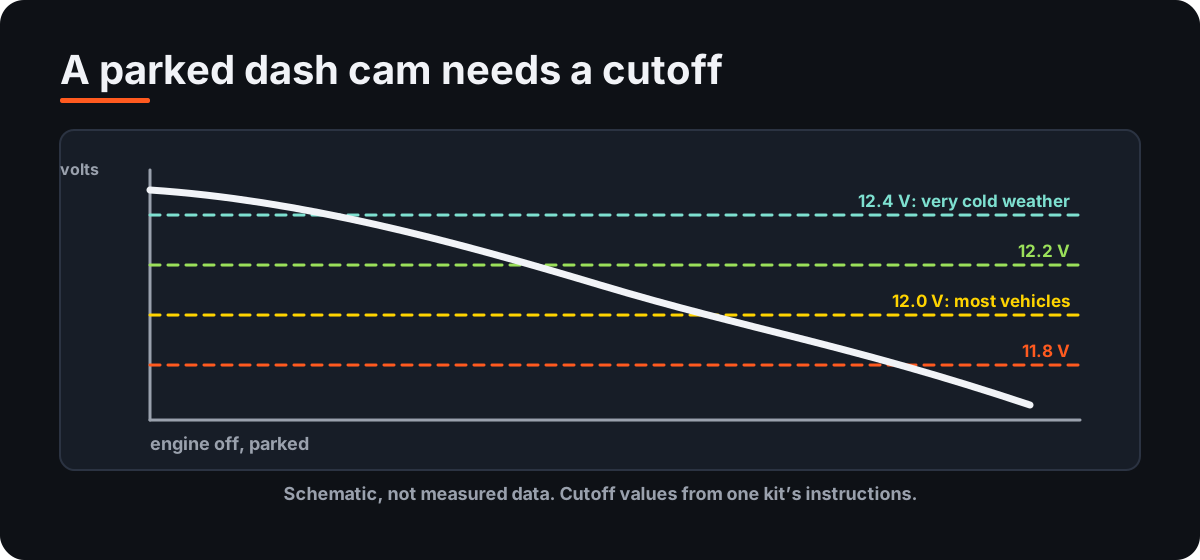
A dash cam in parking mode draws from the battery while the engine is off. A hardwire kit with a low voltage cutoff watches the battery and shuts the camera off before the vehicle can no longer start. The cutoff number matters. VIOFO's 3-wire hardwire kit lists settings of 11.8, 12.0, 12.2 and 12.4 volts. Its instructions recommend 12.0 V for most vehicles and 12.4 V in very cold weather, so enough charge is left to crank the engine on a freezing morning.
The wiring can be perfect and the install can still strand the customer. If it is going to be cold, raise the cutoff. If the vehicle sits for long periods, tell the customer what a parked camera does to a battery, and set expectations in the closeout, not after the callback. Other kits use different numbers, so read the instructions for the one you are installing.
Leave the customer with two things. First, a clear explanation of what you did in plain words, which takes thirty seconds and builds more trust than any brochure. Second, a clean dash with no tools, scraps or loose clips. A tidy finish tells the customer the hidden parts were done right too.
Take the final five questions, then put your skills under the clock. Your best scores are saved on this device and add to your rank.
Play the Install Bench Try Find the Fault
Reconnect the negative terminal, turn the ignition on and confirm the device powers up, confirm location and ignition status, drive about five minutes, put the dash back together and verify, and check for fault codes before and after.
A setting on a hardwire kit that shuts the dash cam off when the battery falls to a set voltage, so the vehicle can still start. VIOFO's 3-wire kit lists 11.8, 12.0, 12.2 and 12.4 V.
Follow the kit's instructions. VIOFO's recommend 12.0 V for most vehicles and 12.4 V in very cold weather.
Built by Installers, for Installers.
Constant. Ignition. Ground. API Signal.
Join the API Signal installer network and find install work near you. We install GPS, dash cams and telematics across GA, SC, NC, TN, VA, AL, FL and MS.