
An ELD records a driver's hours of service straight from the truck, so logs are kept automatically instead of on paper. We install ELDs across Georgia, South Carolina, North Carolina, Tennessee, Virginia, Alabama, Florida and Mississippi, connected to the truck's diagnostic port with a secure harness and a driver display mounted where it is safe to use.
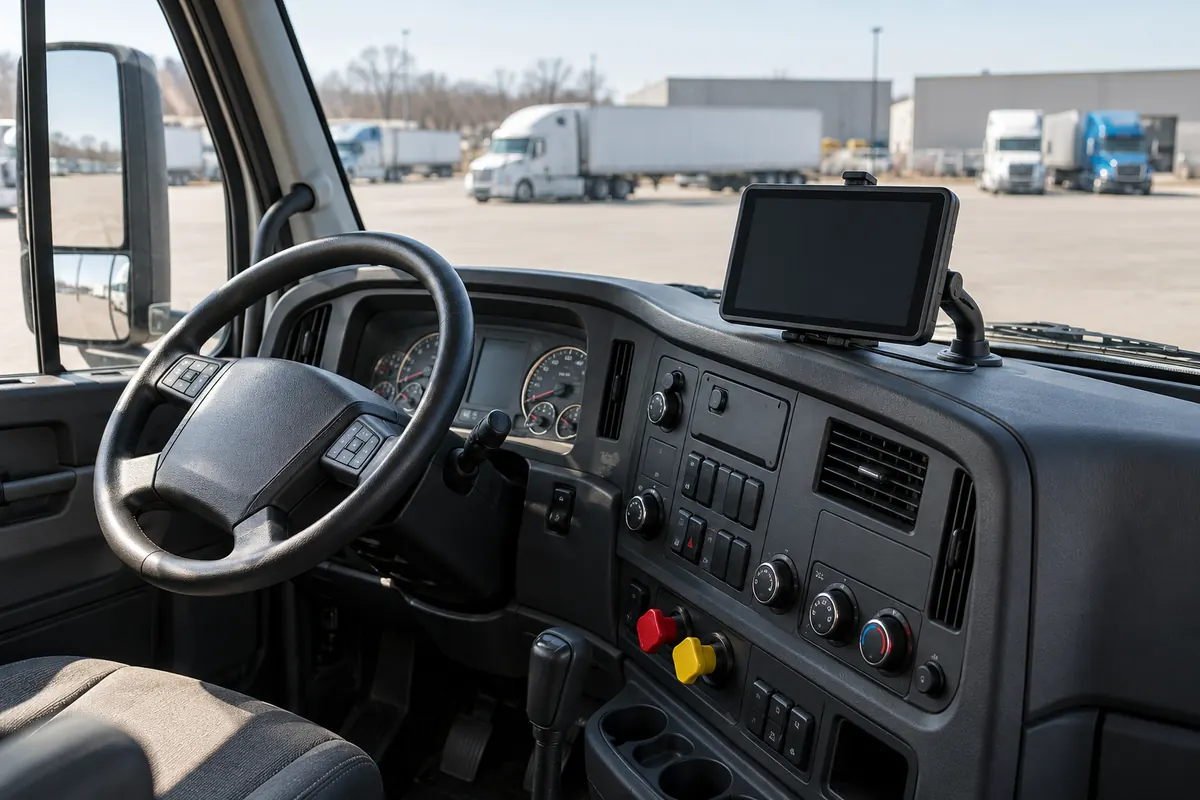
An electronic logging device, or ELD, connects to a truck's engine and records driving time automatically. It logs when the truck moves, how long it drives and where, and the driver uses a screen in the cab to mark on duty, off duty and sleeper time. The Federal Motor Carrier Safety Administration (FMCSA) requires ELDs for most drivers who have to keep records of duty status, in place of paper logbooks.
An ELD is not the same thing as a GPS tracker, though they often share the same box. Many fleet telematics devices do both jobs: they track the truck for the office and keep the driver's logs for compliance.
The short answer is most commercial drivers who are required to keep logs. The rule has exceptions, and these are the ones fleets ask us about most:
Whether your drivers qualify is a compliance question, not an install question, so check with FMCSA or your safety advisor before deciding. This is general information, not legal advice. Our ELD compliance and GPS tracking article goes further into how the two fit together.
The ELD reads engine data, so it connects to the truck's diagnostic port. On heavy duty trucks that is the 9-pin port, or the 6-pin port on older heavy duty vehicles. On light duty trucks it is the OBD2 port. We use a Y-split harness, so the port stays free for a mechanic's scan tool and nothing is unplugged every time the truck goes in for service.
The connection is only half the job. A device left hanging under the dash gets kicked loose by a driver's boot, and an ELD that loses its connection leaves gaps in the logs that the driver then has to explain. We mount the device and route the harness so it stays put. Port pinouts and wire colors are in our Vehicle Wiring Database.
The driver uses a tablet or phone to see and edit logs and to show them at a roadside inspection. It needs a solid mount within reach, out of the line of sight through the windshield, and a power supply that won't drain the truck's battery overnight. A loose suction cup mount falls off on the first rough road, so we use fixed mounts suited to the dash.
FMCSA keeps a list of registered ELDs, and the device you use has to be on it. Check that list before you buy, and ask the provider how the device handles your trucks: heavy duty, light duty or a mix. If you already run a GPS tracking system, ask whether it can do logs as well, so you aren't paying for two devices on the same truck. See all the types of GPS trackers and fleet systems we install for how ELDs fit with the rest.
Common questions
It connects there, on the 9-pin, 6-pin or OBD2 port depending on the truck. We use a Y-split harness so the port is still free for service, and we secure the device so it doesn't get kicked loose.
Often, yes. Many fleet telematics devices do both. Ask your provider whether yours does before buying a second box.
Trucks with engines older than model year 2000 are one of the exceptions. Check with FMCSA or your safety advisor for your situation.
We install the ELDs fleets choose and can supply equipment with the install. Ask when you request a quote.
We install across Georgia, South Carolina, North Carolina, Tennessee, Virginia, Alabama, Florida and Mississippi, at your yard, on your schedule. Call or text 803-513-1009.
Constant. Ignition. Ground.
API Signal